he first vision board I ever made, I hid from the people I grew up with.
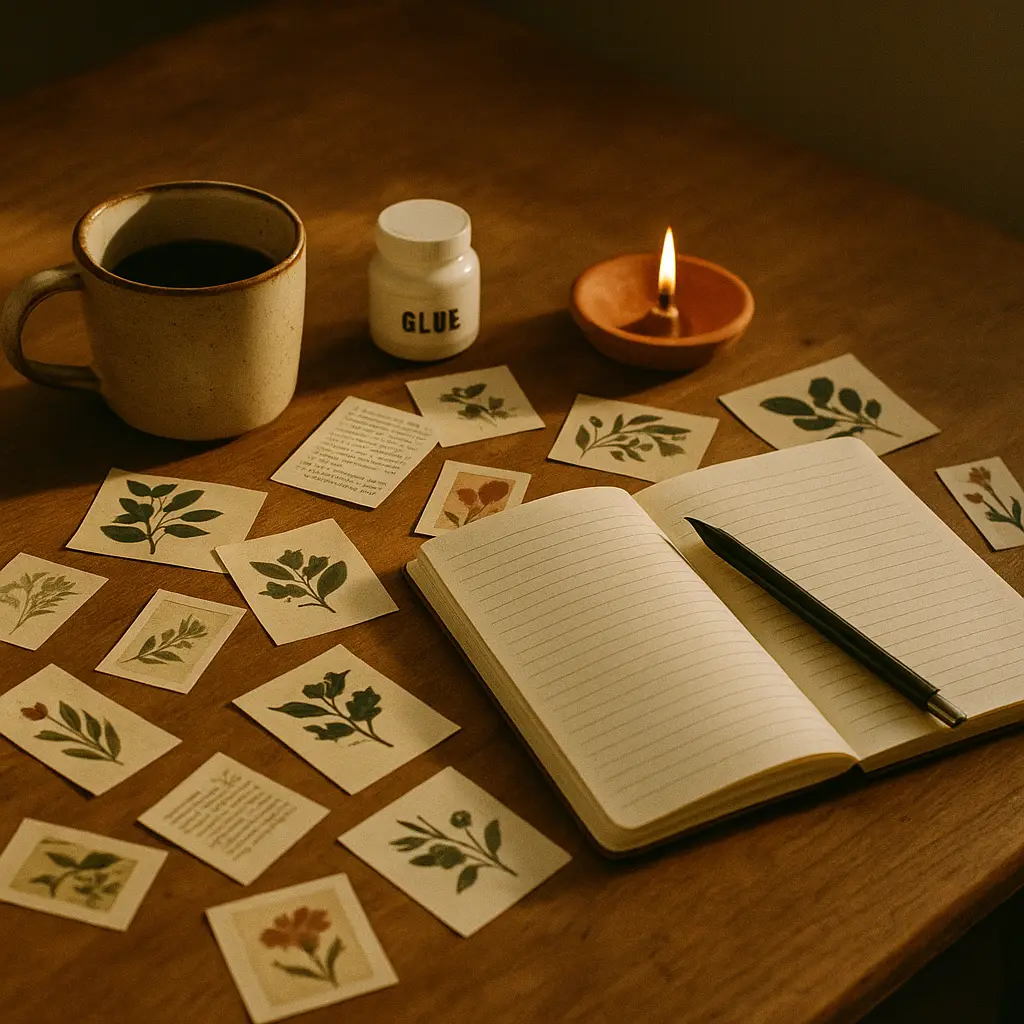
Not because I was ashamed of wanting things. I had spent a lifetime in a household where wanting too much was its own kind of sin, so I had learned to want quietly. But because I knew what they would say when they saw the magazine cutouts and the printer paper and the hot glue gun on the table. They would say it was tempting fate. They would say we put our trust in God, not in pictures on a poster.
And the thing is, that wasn't the wrong question to ask.
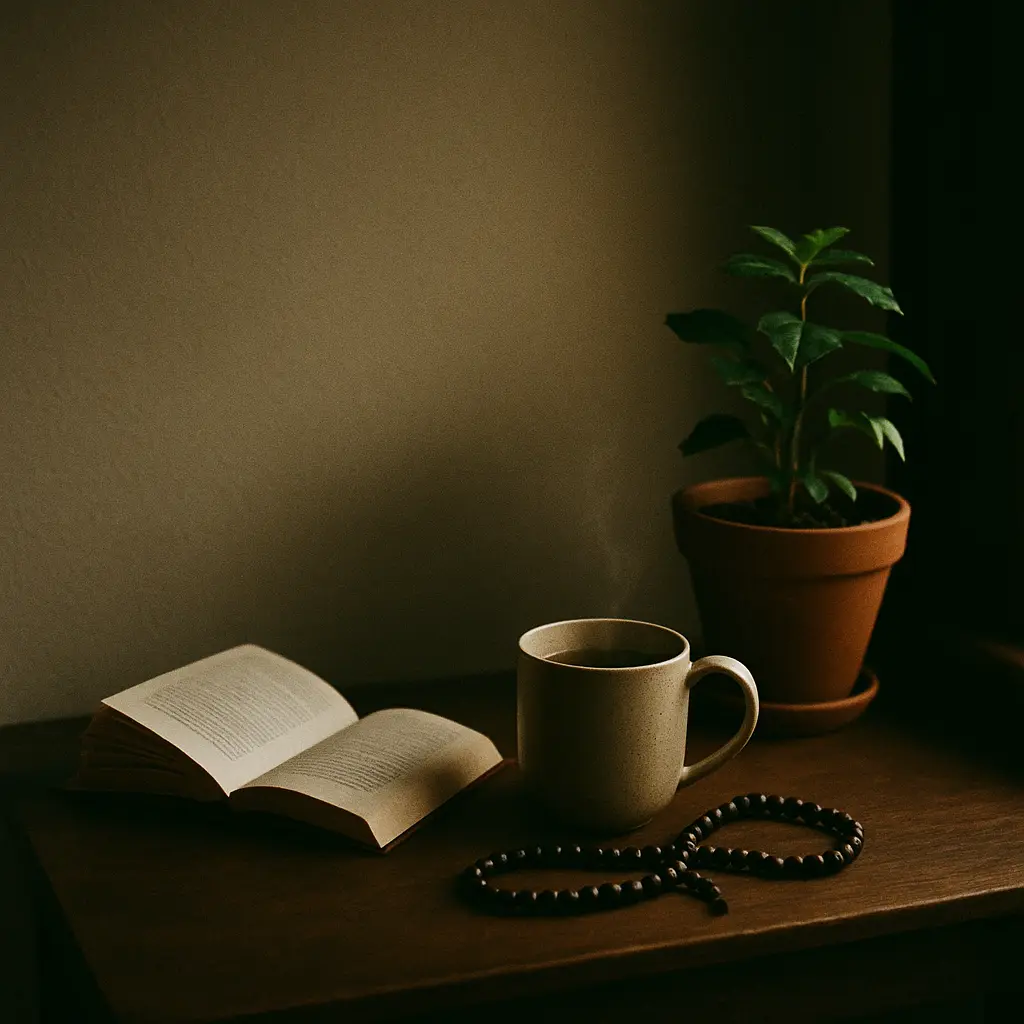
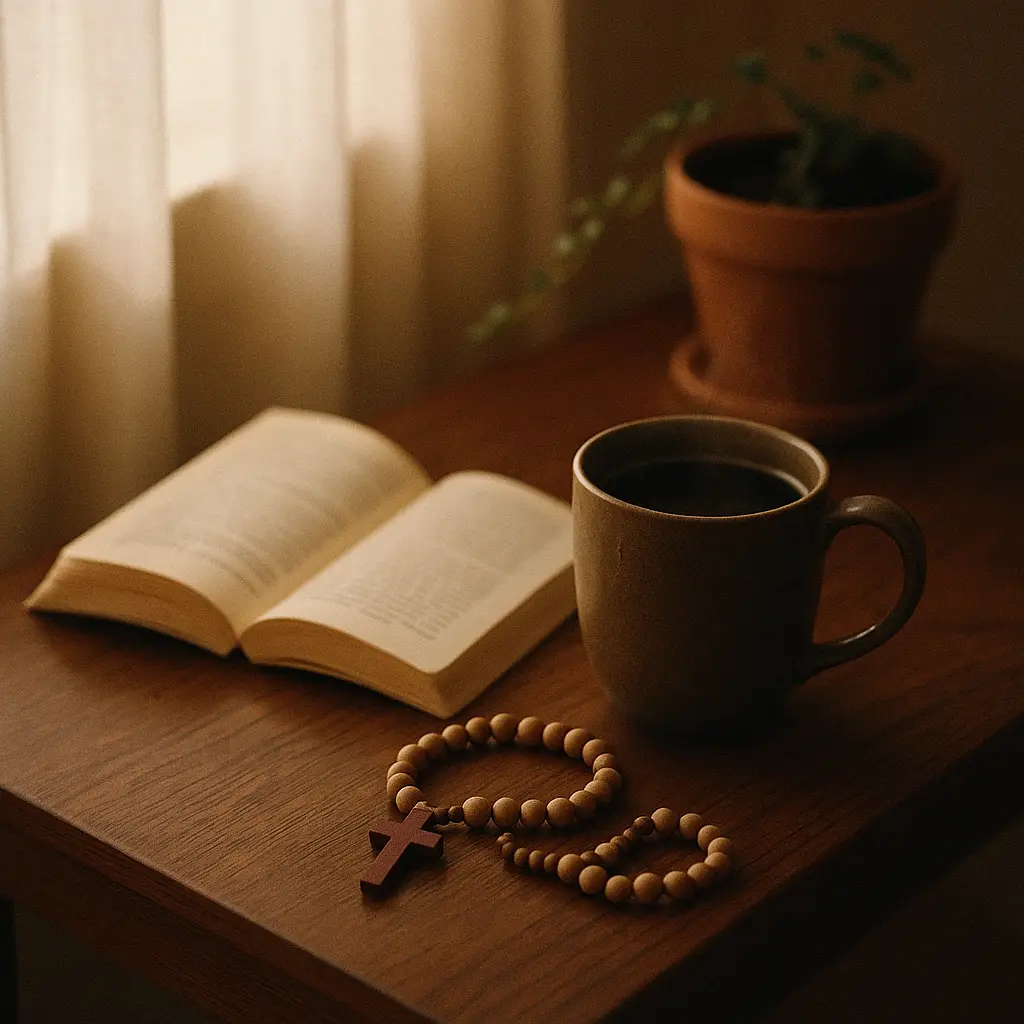
I grew up in the faith. Not cultural, not Christmas-and-Easter, but weekly mass, rosary beads, Ash Wednesday forehead, the full thing. There was a rosary looped around a bedpost and prayers said out loud in a voice just above a whisper, the way you do when you're talking to someone in the next room. Faith was not abstract in that house. It was physical. It was in the worn edges of the pew, the smell of incense, the specific weight of guilt that settles in your chest when you want something and don't know if you're allowed.
So when I found myself at a low point, burned out and theologically confused, I didn't have a tidy way to think about any of it.
I had come to Neville Goddard's The Power of Awareness, listening in the dark, the way you do something you're not sure is allowed. And one of the first things that struck me was how much of it sounded like prayer. The instruction to imagine vividly. The insistence on feeling as if the thing were already real. The emphasis on belief as the operative mechanism.
Mark 11:24. Neville quotes it. I recognized it before he finished the sentence.
"Whatever you ask in prayer, believe that you have received it, and it will be yours."
That verse had been in my life since before I could read. And here it was, cited by a 20th-century mystic who had never, as far as I could tell, set foot in a Catholic church, as the foundational instruction for the practice he was describing.
So I want to write about vision boarding specifically, because it is the most visually literal form of manifestation practice, and because it draws more suspicious looks from Christian readers than almost anything else in this space. And I want to be honest about where I have landed, years in, as someone who takes both Scripture and the practice seriously.
The Object of the Suspicion
The store has products I'd point a friend toward. Honest reviews, no aggressive upsells.
Let me be clear about what a vision board actually is, because I think a lot of the theological objections are aimed at a caricature.
A vision board is a collection of images and words that represent things you want to call into your life. You put them somewhere you will see them regularly. The idea is that the repeated exposure to those images primes your mind, your attention, your emotional state, toward the outcome you want. You are not casting a spell. You are not pledging allegiance to the universe instead of God. You are, at the most literal level, writing down what you want and looking at it often.
Now, if you want to make a theological argument against that, you have to be able to say clearly: Christians should not write down what they want. Christians should not visualize their hopes. Christians should not take their desires seriously enough to give them a physical form.
And when you put it that way, that argument falls apart pretty quickly. Because that is not what Christian teaching says. Habakkuk 2:2 says to write the vision and make it plain. The psalms are full of people pressing God on specific desires. Hannah wept and prayed for a son with so much specificity that the priest thought she was drunk. The blind man who called out to Jesus did not say "whatever you think is best." He said, "Rabbi, let me recover my sight."
Specificity is not a secular virtue that crept into spiritual practice. Specificity is present in the oldest texts we have.
What the real theological concern is, I think, is idolatry. The worry that the images on the board become the object of the desire, that the board itself becomes the mechanism of change, that we start trusting the picture of the house instead of the God who provides the house.
And that is a legitimate concern. Worth sitting with, actually.
Where the Practice Gets Misread
Here is the thing about manifestation practice that I think gets misread most often in Christian contexts: the images are not the point. The images are a tool for the internal state.
Vision boarding works, when it works, because looking at images of what you want helps you practice feeling as if those things are already yours. That feeling, that internal orientation of already-having rather than desperately-wanting, is what Neville would call operating from the end. And operating from the end is, structurally, exactly what faith looks like in Hebrews 11:1.
"Now faith is confidence in what we hope for and assurance about what we do not see."
Confidence in what you hope for. Assurance about what you do not see. Sitting with that for a second, because what is that if not the internal stance that vision boarding is trying to cultivate? You are not seeing the thing yet. You are practicing the assurance. The board is the physical object you use to help your nervous system and your imagination hold the assurance steady.
I am not saying Paul was recommending vision boards. I am saying that the internal mechanics described in Hebrews 11:1 and the internal mechanics described in good manifestation teaching are pointing at the same thing. Belief that precedes evidence. Assurance before sight.
The question becomes: who are you giving credit to for the outcome?
And I think this is where the practice gets used carelessly by people who should know better. If you make a vision board and your operating assumption is "the universe owes me this because I put it on the board," you have missed the point both theologically and practically. But if you make a vision board as a prayer aid, as a visual articulation of what you are trusting God to bring into your life, as a daily reminder of what you are holding in faith, the theological ground shifts considerably.
What the Old Prayer Would Have Called It
The prayer I grew up around reached for things it never asked for out loud. That's the only way I know how to describe it. Someone would sit with the rosary and you could see their lips moving and they'd never tell you what they were asking for, but there was that particular posture of specific wanting that I recognize now because I've learned to cultivate it myself.
What that was, in the vocabulary of the practice: holding an image in mind and feeling into it. Operating, in the most literal possible sense, from the end. Not petitioning some distant authority with a long list of requirements, but communing with a God believed to be already present and already holding the answer, and pressing yourself into alignment with that answer.
A vision board? No. There was a rosary and a picture of the Sacred Heart above the dresser and a particular chair where prayer always happened. Those were the objects. The objects that helped the body and the attention hold steady on what was being trusted.
The form is different. The mechanics are identical.
When I eventually described the manifestation practice to people from that world, the language landed uneasily at first. There were real conversations, the kind that get uncomfortable before they get clear. But when I described what I actually did, the sitting still, the imaging, the feeling-into, the gratitude that precedes receipt, the response I got was: that sounds like contemplative prayer.
Which is not wrong either.
The Idolatry Question, Handled Seriously
I don't want to wave away the idolatry concern because I think it is the genuine heart of the theological objection, and I want to handle it with care.
The first commandment is not a minor piece of the tradition. It is the first one. You shall have no other gods before me. And the history of the Israelites in the Hebrew scriptures is, in large part, a repeated story about what happens when a people starts attributing their outcomes to something other than God. The golden calf. The Baals. The high places. Over and over, the problem is not wanting things. The problem is crediting the wrong source.
So the question for a vision board is real: are you treating the board as the mechanism? Are you placing your faith in the practice rather than in God?
And my honest answer is: you can. Some people do. I don't think it's safe to pretend that the cultural packaging around manifestation, especially in its more secular social-media forms, doesn't sometimes edge into exactly this territory. "Put it on the board and the universe will deliver" is a sentence that has no God in it, and if that is your operating framework, the theological concern is legitimate.
But the solution isn't to throw out the practice. The solution is to be clear about who you are praying to.
For me, this was not actually a complicated revision. I grew up with a God who was described as the Father, as provider, as the one who knows what you need before you ask. That God is not threatened by specificity. That God is not offended by a picture of the apartment you want or the book deal you're holding in faith. That God, as far as I can tell from the tradition I was raised in, is the source of the desire in the first place.
If the desire is oriented toward flourishing, toward good work, toward love, toward health, there's a theological tradition stretching back through Thomas Aquinas to Augustine that says those desires are not suspect. The heart ordered toward genuine good is a heart in alignment with its maker.
The vision board is just where you give those desires a physical home.
Manifestation Practice and Prayer: The Actual Difference
There is a real and interesting question about whether praying and manifesting are the same thing, or whether they are similar but distinct practices that happen to overlap. I want to be honest about the differences I perceive, not just smooth them over.
Prayer, in most Christian theology, is relational. It is addressed to a Person. There is a thou involved. You are not just adjusting your internal state; you are communicating with a being who has personhood and agency and who may respond in ways that are not what you expected or asked for. The theological tradition around prayer includes the possibility of "no," or "not yet," or "something better," in ways that straight manifestation teaching doesn't always account for.
Manifestation practice, in its Neville Goddard form, is primarily about assumption. You assume the state of the wish fulfilled. The external world rearranges to match. There is no thou in that framing. There is law, not person.
I hold both. I am not going to pretend this creates zero tension, because it does. But the tension is not insurmountable.
What I have found over years of practice is that the two reinforce each other more than they conflict. Prayer, at its best, involves the kind of specific, felt, believing engagement that Neville describes. And manifestation practice, at its best, involves a surrender to circumstances-unfolding-as-they-will that looks a lot like "Thy will be done." The practitioner who insists she can control the specific mechanism by which her desire arrives is usually someone who is still learning. The mature version of the practice involves planting the seed of the assumption and releasing the how.
Which, as any contemplative will tell you, is very close to what they mean by abandonment to providence.
For anyone who wants to go deeper on the theological specifics, I wrote about this directly in Is Manifesting a Sin? An Honest Christian Perspective, and separately in Is Manifesting Against Christianity? What the Bible Actually Says. The short version is that the question is more complex than the dismissive "it's witchcraft" camp and the dismissive "God is just the universe, relax" camp both allow for.
The Hidden Board and What Happened After
Whatever you're going through, the store has a small curated catalog of products I'd point a friend toward.
I made the vision board after the worst of it had passed, after I'd found Neville's work, after the first openings had started to appear. I had already seen enough to believe that something real was happening in my interior life and its exterior results, and I wanted a physical object that held the shape of what I was trusting toward.
On it, I put an image of a simple apartment with good light and plants. A picture of someone writing at a table. A word: enough. Not abundant, not wealthy, just: enough, and more than enough, and secure. I put an image of two people having dinner, not because I was manifesting a relationship in some calculated way, but because I wanted to include it in the picture of the life I was orienting toward.
I also, and I want to tell you this part, wrote a small prayer at the bottom of the board. It was barely a sentence. Something like: This or better, in accordance with what is truly good. The faith I grew up in required that caveat. I could not fully let go of the "Thy will be done" that had been in me since childhood. And I think, looking back, that was the right instinct. That phrase was the theological hinge that kept the board from being an exercise in control and kept it an exercise in faith.
Within a couple of years, the debt I had carried through my entire working life was gone. The work had stabilized. The cat was asleep on the chair next to my desk one afternoon and I was working in my own place with the window open, and it was the exact shape of what I had put on the board, in a form I would not have been able to engineer.
I eventually showed the board to someone from the world I grew up in. They looked at it for a while. They asked about the prayer at the bottom.
They said: that's just a novena that you made yourself.
And maybe that's right.
Making One Without the Theological Anxiety
If you are a Christian who wants to try this and you're worried about whether you're crossing a line, here is what I would actually suggest.
Start by asking yourself what you are trusting. Not what you are wanting, but what you are trusting. If the answer is: I'm trusting that God is the source of provision and this board is a way for me to articulate and hold my specific petitions in a tangible form, you are in solid theological territory. The act of writing the vision is in Scripture. The act of believing before you see it is in Scripture. The act of being specific about your desires before God is all over the Psalms.
If the answer is: I'm trusting that the board itself or the universe will deliver based on the law of attraction, that is a different orientation, and it's worth noticing it.
You can also write your prayer at the bottom. I still do this. It anchors the whole thing in relationship rather than mechanism.
One practical thing: include images that represent states and feelings, not just objects. The apartment is fine, but include something that represents peace, or freedom, or belonging, because those are the actual things the apartment is standing in for. The closer your images get to what you actually want at the level of felt experience, the more aligned the practice is with what prayer is trying to do anyway.
And then, when you have made it, let it do its work. Look at it. Feel into it. Let your imagination and your nervous system practice the reality of it. And release the how entirely to something larger than your own planning capacity.
That, friend, is what faith looks like when it has a craft project attached to it.
The store has a small curated catalog of products that complement this kind of work, if you want tools alongside the reading.
The Board I Keep Now
My current vision board is less dramatic than the first one. It lives on the inside of my closet door, which means I see it first thing in the morning and last thing at night without having to make it a performance.
On it are: a kitchen with evening light. A handwritten page. A word in large type that I cut from a magazine. A plant. A printed line from Mary Oliver's "The Summer Day" that someone gave me years ago.
No dollar amounts, no timelines, no demands. Just the shape of a life that feels like itself.
And at the bottom, the same small prayer. This or better, in accordance with what is truly good.
I still go to mass occasionally. I still find something in the physical ritual, the incense, the particular posture of kneeling, the way the words are exactly the same as they were when I was a child, that locates me in something larger. That hasn't gone away. And the practice hasn't replaced it. They occupy different rooms in the same house.
The vision board is not a contradiction of my faith. It's an expression of it. A way of saying, out loud, in paper and glue: I believe that good things are possible for me. I believe that my desires are not shameful. I believe that the life I am oriented toward is real and coming toward me.
And I believe that the God I was raised to trust is not threatened by my specificity.
That is this is real, friend. Not a workaround. Not a loophole. The work.
Frequently Asked Questions
Related reading: