here was a period, somewhere in my mid-twenties, when I had a folder on my laptop called "him."
I'm not proud of the name. Inside it were screenshots: a certain jaw, a certain kind of apartment, a vague composite of everything I thought I was supposed to want. A man who was probably tall, probably worked in something creative but also stable, probably had opinions about restaurants. I had assembled this folder with real care and then stared at it periodically like it was a contract I was waiting for the universe to co-sign.
Nothing happened, obviously.
The Folder Was the Problem (and I Didn't Know It)
The store has a small curated catalog of products that complement this kind of work, if you want tools alongside the reading.
I tell that story now because it is, embarrassingly, exactly what most vision boards for love are doing. They are folders. They are a collection of very specific faces, very specific ring styles, very specific brunch scenarios, assembled with intention and then offered up as a request so narrow that almost nothing real could match it.
Someone who has heard every iteration of my practice over the years once said something I think about often. She was skeptical, as she tends to be, and she framed it as a logic problem: "If you're trying to attract something you haven't experienced yet, why would you trust yourself to accurately picture what it looks like?" She meant it as a challenge. I took it as an instruction.
She was right. When I was building that folder, I was selecting from what I'd already seen, what had already been offered to me as an image of desirability or love or a good life. I was drawing from a very limited archive. And then I was presenting that archive as my whole imagination.
The problem with most vision boards for love has nothing to do with having a vision board. It has everything to do with what you're actually reaching for when you build one.
What You're Actually Reaching For
Neville Goddard's premise, which I have returned to constantly in the years since someone first pointed me toward The Power of Awareness, is that your assumption is the operative fact. What you assume to be true about yourself, about what is available to you, about what you deserve, is what gets expressed in your outer experience. The assumption is the cause. The circumstances are the effect.
A vision board, in Neville's framework, is not a wish list. It is a tool for occupying a state. The images and words on it are prompts. They exist to help you feel what it would feel like to already be the version of you who is loved fully, who is in a relationship that works, who wakes up next to someone and feels safe. The images are supposed to get you into the state. They are not the state itself.
This distinction is the one that most vision board tutorials skip entirely. And skipping it is the reason so many people make a beautiful board, stare at it for six weeks, and then feel worse about being single than they did before they started.
Because here is what actually happens: you put a very specific image of a very specific type of person on your board. You stare at it. And then your brain, being your brain, starts running the gap between where you are and what is on the board. You start noticing all the ways your current life does not look like the board. You track the absence. You practice the feeling of lack, dressed up in very pretty magazine cutouts.
This is not visualization. This is a comparison loop with better aesthetics.
What I Did Instead (After a Lot of False Starts)
By the time I got serious about the soulmate work, sometime in 2023, I had been sitting with Neville's texts long enough to understand that I needed to approach the board completely differently.
I started with a question: What does it actually feel like to be loved the way I want to be loved?
Not what does he look like. Not what does the apartment look like. Not what does the proposal look like. What does it feel like. In my body. On an ordinary Tuesday. Not the highlight reel, but the Tuesday.
The answers surprised me. Safe. Unhurried. Seen without having to explain myself. Able to be quiet in a room with someone else and have it feel easy instead of loaded. Laughed at in the good way, not the diminishing way.
None of those things can be cut out of a magazine. None of them have a specific face attached. All of them are states. And states are what you can actually practice. States are what the inner work is for.
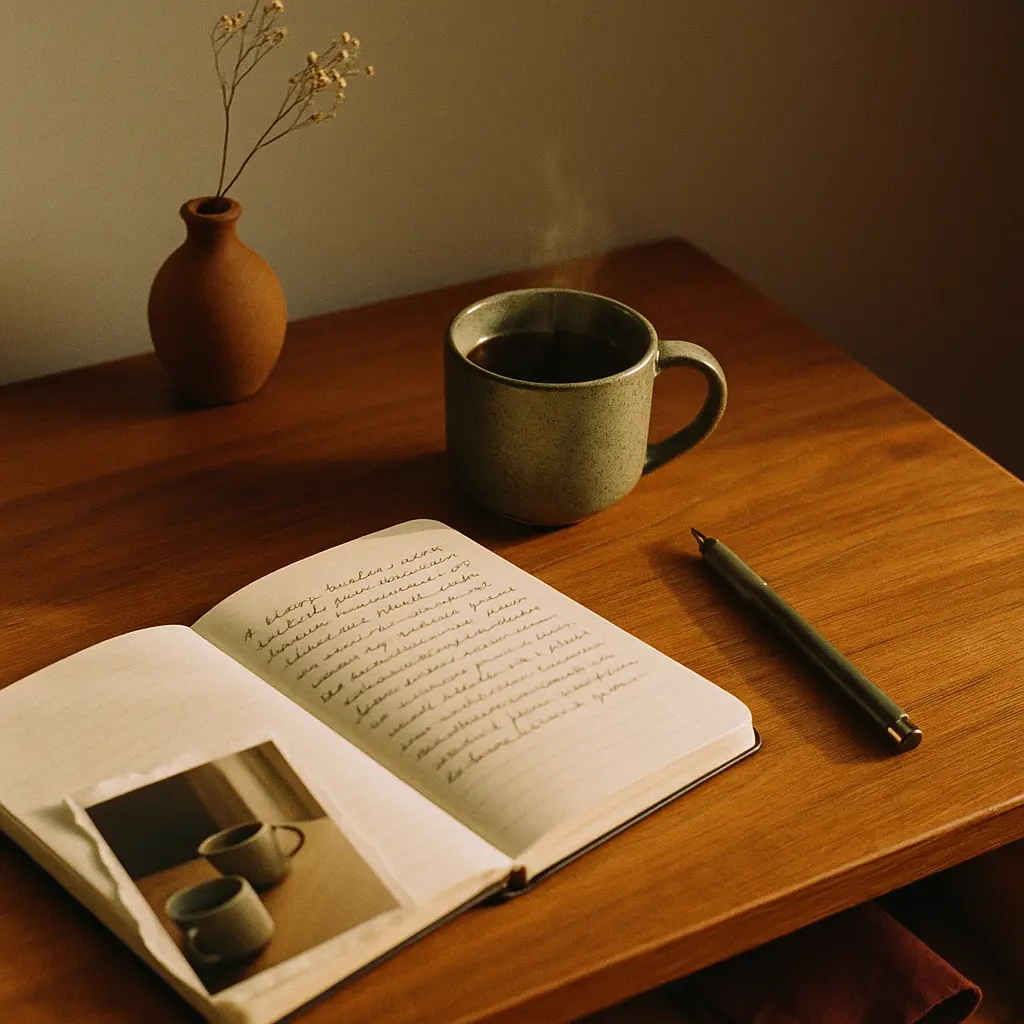
So I built two things. One was a board of images and words that evoked those feelings for me specifically. A picture of a sun-lit kitchen table with two mugs on it. A line from a Nora Ephron essay about being someone's person. A photograph of a couple walking, faces not visible, a particular quality of ease in how they moved together. Nothing was specific about a face or a profession or a timeline.
The second thing was a written statement. One paragraph about how it felt to already be in this relationship. Written in first person, present tense. Not "I want" or "I am manifesting" but I have. I live from it. I close my eyes and practice the feeling of the Tuesday. The unremarkable, wonderful Tuesday.
And then the relationship arrived, in a completely ordinary way that I could not have pictured in any folder.
The Specific Person Trap
I want to spend some time here because this is where most people push back. The question is almost always some version of: "But what if I already know the specific person I want? What if I'm not trying to attract someone new, I'm trying to come back together with someone I've lost, or deepen a connection with someone already in my life?"
This is the territory where the practice gets really nuanced and I'm not going to pretend it doesn't.
Neville does address this. The premise holds the same: you cannot make another person do anything from the outside. What you can do is occupy a state, embody a self-concept in which the relationship exists, and move from there. But a vision board for a specific person requires something the generic soulmate board does not, which is that the images and prompts need to evoke the feeling of the relationship, not the person's face.
A photograph of him is not a tool for entering a state. A photograph of him is a prompt for longing and absence. The brain looks at the face and immediately starts tracking how far away that face is from being in your presence right now.
What works, in my experience of the practice, is different. A word that represents how you feel when you are with them. An object that reminds you of a moment that was real, that you can use to access the feeling of that moment. A phrase that you want to be true, written as if it already is. The board becomes an altar to the feeling of the relationship, not a portrait gallery of the person.
What I did, long before there was any actual person in my life, was practice the feeling of that particular ease without attaching it to any face. Because attaching it to a face meant I was practicing the absence of that face. And absence is a state I had already mastered. I needed a different one.
How to Actually Build It
There is no single correct format for a vision board for love. A physical board is not more or less effective than a digital one. What matters is what you're doing when you interact with it. (If you want the mechanics of building a digital board specifically, the Digital Vision Board: Step-by-Step Tutorial covers the practical tools without the woo-to-English translation work you'd otherwise have to do yourself.)
What I look for, and what I'd suggest, is this:
First, curate for feeling, not for specifications. Every image and word on your board should be there because it triggers a somatic response in you. Your chest should soften slightly when you look at it. Your body should register something. If an image is there because it's aspirational but doesn't actually move you, it is dead weight. Cut it.
Second, include at least one thing that represents you, not the relationship. A version of yourself that you want to inhabit. A woman who is not waiting. A woman who has already arrived somewhere within herself. The relationship you want is not arriving to complete you. It is arriving to accompany you. The board should reflect that.
Third, write something. A short paragraph, a line, a phrase, something in your own handwriting if you're using a physical board. Your words carry your specific frequency in a way that stock imagery simply doesn't. Neville's instruction is to think from the wish fulfilled, not of it. Write from inside the state. One sentence is enough.
Fourth, decide how you're going to use the board. This is the piece most people skip. The board is not decoration. It is a practice tool. I used mine during a specific part of my evening routine, a few minutes of deliberately entering the state, feeling the feeling, and then releasing it. Not staring at it anxiously all day. Not refreshing it with desperation. A brief, intentional practice and then letting go.
The How to Make a Vision Board That Actually Works piece goes deeper on the general mechanics of curation and use. What I'm adding here is specific to love work, where the temptation to get specific and literal is higher than in any other category.
The Part Nobody Wants to Hear
There is a version of this work that is avoidance dressed as manifestation. I have done it. I have made beautiful boards and beautiful journal entries and beautiful playlists as a way of not going on a date, not having a real conversation with someone I liked, not doing the uncomfortable work of actually being vulnerable with another human being in real time.
The vision board is not a substitute for presence. The inner work is not a reason to become a hermit who has very organized feelings.
Bessel van der Kolk's observation (which he explores through a bodywork lens in The Body Keeps the Score) is that trauma and painful history live in the nervous system, not just in the mind. A lot of the reason we struggle to let love in has nothing to do with our beliefs and everything to do with our body's prediction that intimacy ends in pain. The board can shift the mental image. But the body needs something different, something more somatic and relational and physical, to actually update its predictions.
I did both. I did the inner work. I also did the nervous system work, the slow and unglamorous practice of learning to stay present in conversation, to not dissociate when someone seemed really interested in me, to tolerate being seen without immediately self-deprecating out of it. Someone who has been doing somatic work longer than I have pushed me toward this piece when I told her my board was beautiful but nothing was shifting. What she said was basically: "Your board is gorgeous. Your body doesn't believe a word of it. Work on the body."
She was right.
On Not Limiting What Can Come
Here is the thing about the relationship that I could not have predicted: none of what made it right was on any list. The small unhurried rituals, the calm, the particular ease of it. I, who had spent years running myself into the ground and had come out the other side of a hard period, did not know that was the thing I needed.
None of that would have been in a folder.
If I had been specific, if I had been looking for the composite I had assembled in my twenties, I would have filtered it out. Or I would have met it and not recognized what was there because it didn't match the image I was attached to.
The practice of not being hyper-specific about love is not passive. It is not the absence of desire. It is a more sophisticated desire: desire for the feeling, desire for the state, desire for the quality of love itself, which is larger than any one face or profession or set of circumstances. It is saying, I know what this feels like and I am available to receive it in whatever form it arrives.
That is a powerful thing to say. And it requires a kind of trust that hyper-specificity actively prevents.
The work is learning to hold your desire precisely enough to practice it but loosely enough that something real can actually reach you.
The Maintenance Question
A vision board for love is not a one-time project. It is a living document, or it should be.
By the time the financial weight I'd been carrying finally lifted, my money board had already become outdated. Not because it was wrong, but because the state I'd been practicing had become the state I was inhabiting, and the board felt like a reminder of a problem rather than a practice. I retired it. I didn't ceremonialize it, I just took it down and made something new.
Love boards work the same way. If looking at the board starts to feel like looking at a gap, take it down. If it still opens something in you, keep it. The question is: does this tool still help me enter the state? If yes, use it. If no, let it go.
And let yourself be surprised by what you find yourself adding over time. Some of the most important images on my board in 2023 had nothing to do with a person. They had to do with me, who I was becoming, how I was learning to occupy my own life. A woman reading alone and liking it. A table with one place setting that was beautiful, not lonely. The version of me who did not need to be in a relationship to feel whole.
That was the piece that changed things. Because the version of me who did not need to be completed by someone else was a much more available person than the version of me who was waiting.
This is real. The inner work connects. The board is one part of it, maybe a small part. But done well, it is a daily practice of choosing to live from the state you want. And choosing that, consistently, over weeks and months, does something.
I cannot tell you exactly what. The how of it is not my department. But I can tell you what happened after I stopped making folders.
If you're looking for structured support alongside this kind of practice, the store has a small catalog worth looking at.
One More Thing About Specificity
I said not to be hyper-specific, and I want to be precise about what I mean, because there is a version of "don't be specific" that becomes its own trap.
Vagueness is not the same as openness. "I want love" is so undefined that the brain cannot generate any useful feeling from it. You need enough specificity to practice the feeling. You need the Tuesday. You need the two mugs on the table. You need the particular quality of being known.
You just don't need the face. You don't need the height or the job title or the timeline or the city or the specific mechanism by which they arrive. Those are the details that belong to how it manifests, and how it manifests is not your job. Your job is the state. The circumstances are the effect.
As Neville Goddard wrote in The Power of Awareness: "Assume the feeling of the wish fulfilled and observe the route that your attention follows." The route is not yours to design. The feeling is.
Your vision board for love is a tool for practicing that feeling. Build it accordingly, and let the route surprise you.
The store has products I'd point a friend toward when the inner work needs more structure than a blog post can give it, honest reviews, no aggressive upsells, just the kind of tools I'd have wanted access to when I was figuring this out from scratch.
And if you're building for 2026 and want a wider frame for what to put on any vision board right now, Vision Board Ideas for 2026 is worth your time. The love cluster is only one piece of what's possible.