here's a version of this tutorial that starts with a Pinterest board and ends with a manifested life. This isn't that version.
What I actually want to talk about is why most digital vision boards don't work, and what the ones that do have in common. Because I've made both kinds.
The Board That Sat in a Folder for Two Years
Whatever you're going through, the store has a small curated catalog of products I'd point a friend toward.
I made my first digital vision board years ago. Canva, free account, a grid of images I found by typing things like "luxury apartment" and "dream life" into Google. I saved it as a JPEG, set it as my laptop wallpaper for about three weeks, and then swapped it out for something else, because the vision board made me feel vaguely guilty every time I opened my computer.
The guilt was information, but I didn't know how to read it yet.
What I know now, after a long stretch with this practice, is that the board wasn't wrong because of what was on it. The images were fine. The problem was what I was doing with it, which was basically nothing. I was looking at things I wanted and feeling the distance between me and them. Every time I opened my laptop, I was practicing the feeling of not having it.
Neville Goddard wrote in The Power of Awareness that the assumption of the wish fulfilled is the creative act. Not the wish itself. The assumption. Sit with that for a second. A vision board that shows you what you want, without prompting you to assume you already have it, is just a mood board. Pretty. Inert.
What Makes a Digital Board Different From a Physical One
The case for going digital is real, and I want to be honest about it rather than romantic about scissors and magazines.
Digital boards are searchable, updatable, and private. You can have one on your phone that nobody sees. You can swap images without reprinting anything. You can organize by category or by feeling. You can make one in an afternoon and refine it over months.
But digital boards also have a specific failure mode: they live in folders. A physical board on your wall is inescapable. A Canva file you haven't opened since March is doing nothing.
So the first decision you make in this process isn't which app to use. The decision is: where will this board actually live in your daily life? If you can't answer that before you start building, the format doesn't matter.
The options I've seen work, for me and for people I know who do this consistently:
- Phone lock screen or home screen
- Desktop wallpaper, rotated on a schedule
- A folder you open during a specific daily ritual (morning coffee, before bed)
- A private Pinterest board you return to with intention, not just to scroll
Pick one. Only one. A board in four places is a board in no places.
Step One: Decide What This Board Is For
Before you open any app, write down, by hand if you can, one sentence that completes this prompt: This board exists to help me feel ___.
Fill in the blank with a feeling, not a thing. "Financially free" works. "Like I have a beautiful home" works. "Like I already have the relationship I want" works. "Rich" is harder to work with than "ease." "Thin" is harder to work with than "at home in my body."
The reason Neville's framework actually matters here is that the goal of any visualization practice is to move your nervous system into the felt sense of the thing, not just to picture it. Bessel van der Kolk's work on how the body holds experience points to the same thing from a different direction: the body doesn't distinguish cleanly between a vividly imagined experience and a real one, when the imagining is felt rather than just seen. Your board should produce a feeling every time you look at it. If it doesn't produce a feeling, it's decoration.
So: what feeling? Write it down. That sentence is your filter for every image you add.
Step Two: Gather Images With a Feeling Test
Now you can open the app. I'll come back to which app in a moment, but first: how to actually choose images.
For every image you consider, run it through one question. Does looking at this image make me feel like I'm already in the life I'm building, or does it make me feel like I'm looking at someone else's life?
That's the whole test. An image of an apartment that makes you feel wistful and separate is the wrong image. An image of an apartment that makes something in your chest settle, that produces something like yes, this is mine, is the right image. The style of the apartment matters less than that felt response.
This is why searching for "dream life" images rarely works. You end up with aspirational stock photography that produces the feeling of aspiring, which is the feeling of not having. Instead, search for the feeling itself. If your sentence from Step One was "I want to feel financially free," try searching: morning light, slow Sunday, no alarm, unhurried kitchen. The images that come back will be quieter. They'll work better.
Does this take longer? Yes. That's the work.
Step Three: Limit the Board
The single most common mistake I see is the board that tries to hold everything. Career, relationship, body, travel, apartment, creative work, family, finances, all at once, in one grid.
I understand the impulse. I made boards like that. But a board with forty images produces overwhelm, not embodiment. You end up scanning it without landing anywhere.
The boards I've found most useful are small. Seven to twelve images, maximum. Each one earns its place by consistently producing the feeling you named in Step One. If an image is just there because it's pretty, or because you feel like you should want that thing, cut it.
This is the point where someone once pushed back on me and asked the question I didn't want to answer: aren't you just curating an aesthetic at that point? And I had to think about it. The answer I came to was that an aesthetic and a practice are different things in the same way that a gym membership and going to the gym are different things. The aesthetic is only as useful as the practice built around it.
Step Four: Build the Board
Tools. Canva works. It's free, it's flexible, and the grid layouts are easy to customize. If you want something that functions more like a private gallery and less like a design project, a private Pinterest board does the job cleanly. Some practitioners I know use the Widgetsmith app to put a rotating image from their board on their phone's home screen, which solves the "living in a folder" problem elegantly.
What I'd suggest for layout: avoid the uniform grid. A uniform grid feels like a catalog. Use varying image sizes. Let one or two images be larger than the others. The largest image should be the one that most reliably produces the feeling you're after. Give it room.
If you want to add words, make them sparse. One phrase, maybe two. The board shouldn't need to explain itself to you.
The Practice the Board Is Meant to Support
Here's where I want to slow down, because this is the part most tutorials skip.
A digital vision board is a tool for a practice. The practice is the state akin to sleep Neville describes in The Power of Awareness, that drowsy, receptive threshold state where the mind is relaxed enough to accept a new assumption. The board is a portal into that state, a way to quickly access the feeling before you enter the visualization itself.
What that looks like, practically: you open the board. You let your eyes land on the image that produces the strongest feeling. You hold that feeling, not the image, just the feeling, in your body for thirty seconds. Then you close the board and close your eyes and let yourself imagine, briefly, a single scene from the life in which that thing is already true. Not a highlight reel. One scene. Specific. Sensory.
Someone once asked me how long this takes. And the answer is: the quality of the state matters, not the duration. Two minutes of really inhabited feeling does more than twenty minutes of effortful staring. Joe Dispenza's work on the relationship between elevated emotion and neurological change points in the same direction: the felt intensity of the experience shapes what the body learns, not the clock time spent.
Can you do this once and call it done? You could. But the practice compounds. I can tell you that the version of this I do now took a long time to be able to do reliably. Be patient with yourself in the early months.
What does a board manifest, actually? I think that's the wrong frame for it. The board doesn't manifest anything. You do, through the sustained, embodied assumption of the wish fulfilled. The board just helps you get to the feeling faster. Think of it as a tuning fork, not a contract.
The store has a small curated catalog of products that complement this kind of work, if you're looking for more structured support alongside what you're building here.
The store has products I'd point a friend toward. Honest reviews, no aggressive upsells.
One Last Thing About the Apartment
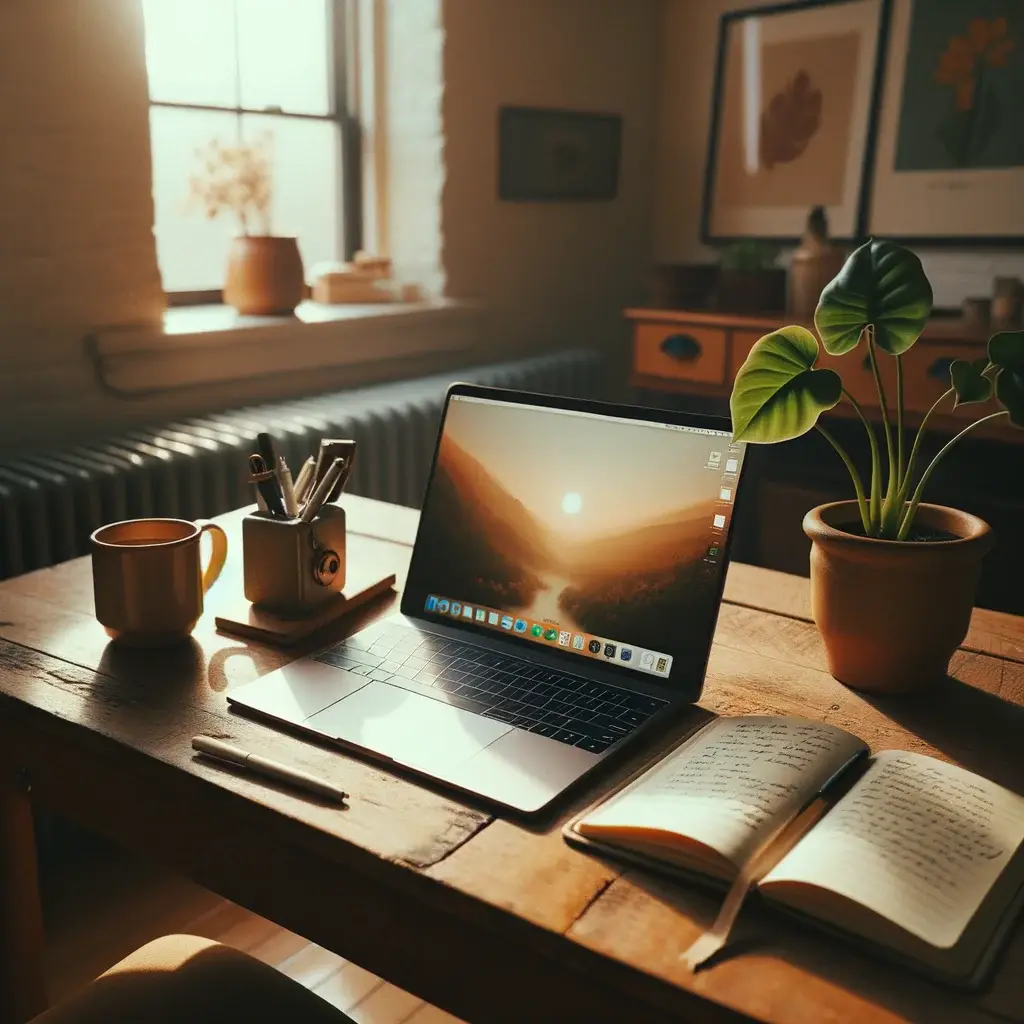
I have a different laptop wallpaper now. It's an image I chose during a season when I was doing the inner work that preceded everything that came later. It's a photograph of a kitchen, warm light through a window, a coffee cup on the counter, nothing dramatic.
Every time I open my laptop, the feeling is: mine. Already mine.
The kitchen in the photograph is nothing like my actual kitchen. That was never the point. The point was always the feeling of that kitchen. The feeling of warmth and ease and unhurried mornings and a life that was already, quietly, enough.
The version of you who already has it doesn't need a more impressive image. She needs the one that makes her feel it. Start there.