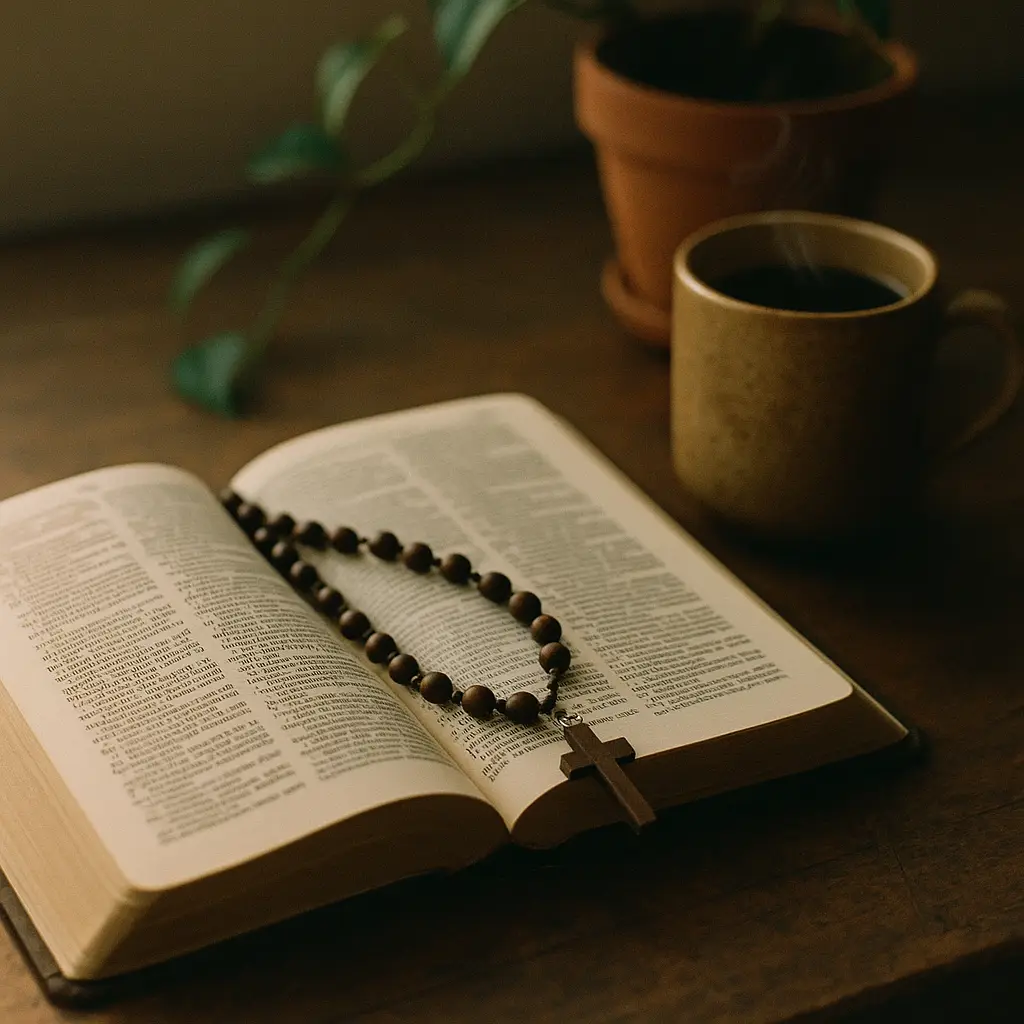
he faith tradition I grew up in never called it an affirmation. It called it prayer, said in the quiet of the morning before the day started.
A prayer said the same way, in the same words, every single day, is a person speaking something they believe into the silence. Repeating it until it settles into the bones. That is, by any definition I can find, affirming.
This is what came to mind the first time someone told me that affirmations were a sin.
The accusation arrived at a specific moment
Whatever you're going through, the store has a small curated catalog of products I'd point a friend toward.
I had just started doing the work in earnest, which at that point meant sitting with Neville Goddard's ideas about assumption and inner speech, and writing sentences in my journal that felt embarrassingly hopeful. Things like I am someone who is financially stable. Things like I am someone who attracts meaningful work.
I mentioned this to someone I knew vaguely from a shared religious background. Not a close friend. Someone I'd run into at a holiday gathering. She got very still when I described what I was doing, and then she said, quietly and with what I think was genuine concern: "That's not prayer. That's sorcery."
She wasn't being cruel. She meant it. And honestly, the religious guilt I'd been carrying since childhood activated immediately. I went home and sat with the question for weeks.
Was she right?
Because here is what I actually cared about: I was not interested in practicing something that violated my faith. I still had a faith. A complicated, fractured, very much alive faith. I wasn't going to just dismiss the concern because it was inconvenient.
So I did something I hadn't done in years. I opened the Bible and started reading carefully.
What the Bible actually says about words
Here is a sentence from Proverbs 18:21 that I wrote in my journal and have not stopped thinking about since: "Death and life are in the power of the tongue."
Not some of life. Not a little life. Life.
The writer of Proverbs understood something about spoken and repeated words that modern Christianity seems, in certain corners, to have gotten very nervous about. Words carry weight. Words spoken with belief shape reality. This is not a New Age idea. This is the first chapter of Genesis. God speaks. Things exist. The pattern is established from the opening pages.
Psalm 19:14 asks that "the words of my mouth and the meditation of my heart" be acceptable. Meditation of the heart. The Psalmist is describing an interior practice, a repeated inner movement of attention, and asking that it be aligned with something good. That is, functionally, what an affirmation is.
I am not a theologian. I want to be clear about that. But I grew up in a tradition that took Scripture seriously, and when I started reading it for myself instead of absorbing what I'd been told about it, I kept finding something I did not expect: a consistent, recurring emphasis on the relationship between what you speak, what you believe, and what manifests in your life.
Mark 11:24 is perhaps the most direct: "Whatever you ask for in prayer, believe that you have received it, and it will be yours."
Believe that you have received it. Present tense. Before the evidence. That is the instruction. Neville Goddard built an entire body of work on that principle, and he quoted Scripture constantly, not because he was co-opting Christianity for marketing purposes, but because he read the same verses I was reading and understood them as an operating manual for consciousness.
The actual theological concern underneath the accusation
When Christians object to affirmations, the concern is usually one of several things. Let me take each of them seriously, because I think they deserve a real answer.
The first concern is idolatry. The worry is that affirming something like "I am abundant" or "I am healed" places the self at the center rather than God. That it is a form of self-worship or humanism dressed in spiritual language.
This is a fair concern if the affirmation is operating from a place of pride or of dismissing God entirely. But most affirmations I use, and most of the ones I see people using in this space, are not claims of independence from God. They are claims of identity. They are saying: this is who I believe I am created to be. That is not idolatry. That is agreement with what the tradition actually teaches about being made in the image of God.
The second concern is divination or sorcery. This is what the woman at the holiday party was worried about. The idea that affirmations are a form of magic, an attempt to manipulate spiritual forces outside of God's authority.
But there is a meaningful difference between divination (seeking hidden knowledge through occult means) and prayer, confession, or inner speech. Affirmations are not spells. They are not directed at spirits. They are not attempting to bypass God's will. They are a form of alignment with an identity. The distinction matters, and the people who collapse it tend not to have looked at what affirmations actually are.
The third concern is presumption. Saying "I am healed" or "I have more than enough" before those things are materially true can look, from the outside, like lying. Like claiming something false. Like bypassing repentance and trust and replacing them with positive thinking.
This one I sat with the longest, because it touches something real. There is a version of affirmation practice that is escapism. That is just refusing to acknowledge reality. It is the thing a rigorous skeptic pushes back on every time the subject comes up: isn't there something a little delusional about telling yourself things that aren't true yet?
And I had to think about what I actually believe. Which is: no. Because the tradition I come from has a very specific word for claiming something as true before it is materially evident. That word is faith.
Faith is the original affirmation practice
Hebrews 11:1 defines faith as "the substance of things hoped for, the evidence of things not seen." Substance. Evidence. Of things not seen. That is not passive waiting. That is a claim about reality made in advance of the material proof.
The entire lineage of faith described in Hebrews 11, which theologians sometimes call the "faith hall of fame," is a record of people who spoke and acted as if something were already true before it was. Abraham left his country for a place he hadn't seen. Sarah received strength to conceive when her body was beyond the age of childbearing. They were not being delusional. They were practicing something that the tradition honors as among the highest forms of spiritual life.
What is confession in the Christian tradition? It is declaring something to be true. The Nicene Creed, recited every Sunday in churches around the world, is an affirmation. "I believe in one God, maker of heaven and earth." That is a stated belief, repeated regularly, with the intention of shaping the believer's orientation toward reality. That is what affirmations do.
The question is not whether Christians affirm. Every Christian affirms. The question is what they affirm, and whether it is aligned with a coherent theology of who they are and what they are allowed to hope for.
I want to ask you something directly, because I think it matters: what have you been affirming, silently, about yourself for the last decade? Not what you've said out loud. What you've said on the inside.
Because I spent years telling myself, on the inside, that I was someone who had to earn her place every single day, that rest was indulgence, that wanting more was greedy, that the anxious grinding was just what adult life was. I was affirming constantly. I was just affirming something that wore me down.
What the tradition was actually doing
I have thought a lot about that early-morning practice of repeated prayer, the kind that has been kept in faith traditions for centuries.
What that practice is is not passive. It is a disciplined, daily, embodied repetition of specific truths a person intends to anchor in themselves. The rosary is one such method. It uses physical sensation (the beads) and rhythmic repetition (the prayers) to move a belief from the intellectual level into something that lives in the body. In the language of contemporary trauma research, you might recognize it as somatic integration. As nervous system regulation through repeated sacred speech.
It is not self-worship. It is not sorcery. It is a person aligning themselves, deliberately and daily, with an identity they want to inhabit: someone held, someone loved, someone not alone in their worry.
That is what I do now. The language is different. The framework I use to understand what I'm doing is different. But the structure is the same.
Repeated speech, directed by belief, toward an identity you intend to inhabit.
The tradition has been doing this for two thousand years. Calling it a sin when it appears in a slightly different form tells me more about the speaker's discomfort with certain words than it does about what Scripture actually teaches.
The verses that changed how I read this
Beyond Mark 11:24 and Proverbs 18:21, a few others stopped me cold when I encountered them.
Romans 4:17 describes God as one who "calls things that are not as though they were." This is in reference to Abraham's faith, and it is the clearest possible endorsement of speaking something into existence before it materially exists. If God calls things that are not as though they were, and we are made in God's image, and we are instructed to walk in faith, then speaking what we believe to be true before it is evidentially true is not a violation of the tradition. It is participation in it.
2 Corinthians 5:7: "We walk by faith, not by sight." The whole Christian life is an invitation to navigate from the unseen rather than the visible. Affirmations are a technology for doing that. They are a practice of keeping your attention on the invisible truth rather than the visible circumstance.
Philippians 4:8 is especially striking: "Whatever is true, whatever is noble, whatever is right, whatever is pure, whatever is lovely, whatever is admirable, if anything is excellent or praiseworthy, think about such things." Paul is giving a direct instruction about the content of inner speech. Direct attention toward the excellent and praiseworthy. That is cognitive work. That is, in the plainest possible language, an instruction to practice affirmative thinking.
I keep coming back to this one because Paul is not saying "wait until things feel excellent before you think about them." He is saying: choose what you think about. Direct your inner speech. This is the work.
Where I think the confusion comes from
There is a real critique to be made of certain forms of positive thinking that have been marketed under Christian or quasi-Christian branding, and I want to honor that critique because I think it explains a lot of the resistance.
The prosperity gospel, in its more aggressive forms, is a genuine theological problem. Treating faith as a transactional mechanism for material gain, promising that God will make you rich if you confess it loudly enough, reducing the complexity of suffering and grace to a cause-and-effect machine: these things distort the tradition. I do not practice that, and I do not teach it. If you are interested in how I think about the line between faith-based manifestation and prosperity gospel co-opting, the article Is Manifesting a Sin? An Honest Christian Perspective gets into that distinction with more care than I can give it here.
The concern about affirmations is often, I think, a displaced concern about prosperity gospel. People have watched a television preacher promise financial blessing if you just say it enough times, and they are rightly skeptical. They import that skepticism onto all forms of inner speech practice, including the ones that are much more careful about what they're actually claiming.
The other source of confusion is a misunderstanding of what affirmations are supposed to do. They are not magic words that change the external world by sheer verbal force. They are a practice of aligning your self-concept with what you believe to be true about who you are. The external shifts come as a result of who you become, not as a result of the words themselves.
Someone still grinding through long weeks at a demanding job asked me once what I was actually doing and whether it worked. I tried to explain it this way: the affirmations are not the thing. The person you become by believing them is the thing. They looked skeptical but also, I thought, a little tired in a way that had nothing to do with the hour.
The thing nobody says about sin
Here is what I actually believe about the sin question, after sitting with this practice and the faith I was raised in: the moral weight of a practice depends on its intention and its object, not on its form.
Saying words repeatedly with belief is a neutral form. It can be directed toward harm, toward self-aggrandizement, toward the displacement of God, toward cruelty. In those cases, yes, there is something spiritually dangerous there. But the form itself is not the sin. The rosary is the same form as a pagan chant if you strip it to the mechanics. Nobody calls the person praying it a sorcerer.
What I am doing when I affirm is this: I am directing my inner speech toward the person I believe God made me to be. I am practicing believing that I am loved, enough, capable, not really broken, not destined for scarcity. I am, in the language of the tradition, walking by faith and not by sight.
I cannot prove this is the theologically correct interpretation. I am not a priest or a scholar. But I am someone who grew up around the quiet repetition of morning prayer, who spent years dismantling herself in service of productivity metrics, who hit a bottom and could not get up, and who found, in a practice that includes both Neville Goddard and Proverbs 18:21, something that held.
That is real. And I don't have a lot of patience anymore for the argument that the holding is a sin.
If you want to think through the specific question of visualization and whether it crosses a different line, the piece Is Visualizing Your Future a Sin works through it from a similar angle. Sit with that for a second before you decide.
The store has a small curated catalog of products that complement this kind of work, if you want tools alongside the reading.
What I actually do now
My practice is not a replacement for prayer. It is not competing with anything I was raised with. It is more like a completion of something that was always present in the tradition but not always named clearly.
I wake up. I make coffee. I sit with the quiet before the day starts and I practice being the version of me who already has what I'm working toward. I do not do this to bypass God or to place myself at the center. I do it because I spent too long walking in the opposite direction, affirming, unconsciously and with full body conviction, that I was not enough and never would be.
The practice is correction. The practice is, in the oldest language I know, metanoia: a turning of the mind.
If that is a sin, then so is the morning rosary. And I am not willing to say that.
The store has a small curated catalog of products that complement this kind of work, including resources for people who are navigating the intersection of faith and manifestation practice, if you want something to take into this alongside your own reading.
But mostly what I want to say is this: read the Bible yourself. Not what someone told you it says. Not the summary version filtered through someone else's anxiety about what you might do with it. Read Proverbs. Read Mark. Read Romans 4. Read Philippians 4:8 and let Paul's direct instruction about what to think about land without immediately defending against it.
And then ask yourself what you've been silently affirming for the last ten years.
Because you have been affirming something. The only question is whether it's been building you up or wearing you down.
Frequently Asked Questions
Related reading: