he first vision board I ever made was, honestly, kind of embarrassing.
Not because the things on it were too big. Because they were too small. Because I cut out pictures of things I thought I was allowed to want and pasted them on a piece of poster board from the drugstore, and then I hid it under my bed for six months. Which tells you everything you need to know about where my self-concept was at the time.
That was during a hard season, not long after everything had come apart. Around the time someone first put Neville Goddard in front of me, when neither of us knew it was going to change anything.
I'm writing this now, years into the practice, and I have really useful things to tell you about vision boards. Practical things. Specific things. But I want to start with the embarrassing version because I think it's the version most people are actually living, and I think that matters more than a list of aesthetic categories.
The Board Under the Bed Is Still Doing Something
The store has products I'd point a friend toward. Honest reviews, no aggressive upsells.
The strangest thing about that first board is that it worked anyway.
Not everything. Not the stuff I didn't actually believe. But the things I really felt something about when I cut them out, the things that made my chest do something involuntary even while my brain was saying you don't deserve this yet, those things showed up. Slowly. Then all at once, the way things tend to.
I think about this a lot. I think about what it means that a vision board stuffed under a bed, made in grief, made half-embarrassed, still held some kind of charge. And I think the answer is what Neville Goddard spent his whole teaching life explaining: the image itself is the lesser thing. What matters is the feeling the image generates. The feeling is the prayer. The image is just the door.
So when I talk about vision board ideas, I want you to hold that in mind. A beautiful Pinterest-perfect board assembled without feeling is a decoration. A crumpled page with three images that really move you is the work.
That said: let's make something that actually moves you, because 2026 is not the year for decorations.
Start With the Feeling You're Chasing, Not the Object
Here is the first mistake almost everyone makes, including me in 2022: you go looking for images of things.
A house. A bank account balance (more on that in a moment). A relationship that looks like a stock photo. A body that looks like a different body.
And then you get frustrated because the board doesn't feel like anything. It feels like a wishlist. It feels like a magazine you found at the dentist's office. You look at it twice and stop looking.
The reason is that you skipped the step that Neville calls assumption. You went straight to the symbol without asking what the symbol represents internally. What does the house feel like from the inside? What does walking through the door of that house feel like at the end of a particular kind of day? What is the texture of the life happening inside it?
Before you look for a single image, I want you to sit with these questions:
- What does the version of you who already has this feel like in the morning?
- What is different about how that version of you moves through a Tuesday?
- What has relaxed in your body that is currently held tight?
The answers to those questions are what your board is actually trying to capture. The images are just shorthand for states of being. And when you know the state first, you will cut images completely differently. You will not grab the picture of the house. You will grab the picture of morning light on a wooden floor and a coffee cup on a windowsill, because that is what you're actually after.
This is also why vision boards made in January often feel better than vision boards made in a hurry: you've had time to sit with the feeling before you start collecting the shorthand.
Categories That Actually Work for 2026
Let me give you the architecture I use now, after years of refining it. These are not the standard vision board categories you'll find in every generic blog post. They are the categories that emerged from taking this seriously as a practice.
The Feeling of Home
This is never just about real estate. Home, as a vision board category, means: where does the version of you who already has your life rest? What does that space feel like? Is it quiet in the mornings? Does it smell like coffee and paper? Is the cat (for those of us with cats) doing something ridiculous in a patch of sunlight? Does the kitchen feel like a place where something good happens?
I'm very specific with this category because specificity is what generates feeling. "A beautiful apartment" generates nothing. "Sunday morning in a kitchen with good light where someone I love is making coffee and I have nowhere to be" generates the nervous system state I'm after.
The Work That Feels Like Yours
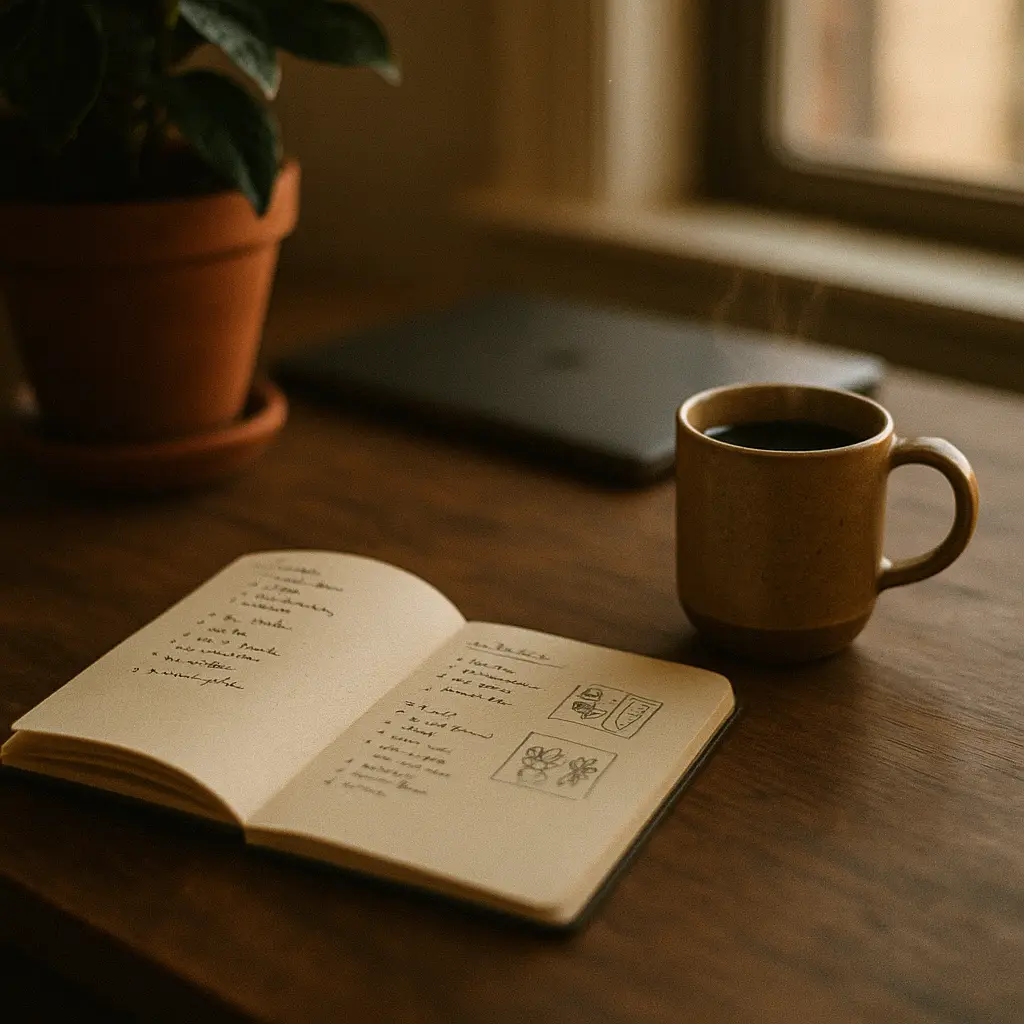
Not "success." Not a corner office or a generic laptop-on-a-beach image. What does the work feel like when it is yours? For me, in 2022, this was a very specific image: a desk with morning light on it and a notebook open. That was it. That was the whole thing. And what I was encoding was not freelance writing specifically but the feeling of doing something in the morning that felt like mine. The ownership. The silence. The choice.
What does work feel like when it belongs to you?
The Body in Ease
I'm going to say something that I think is important: I don't use images of other people's bodies on my vision board. I tried it in my first version and it created a low-level dissociation every time I looked at it, a weird gap between where I was and where I was "supposed to be." What works better for me is images of ease. A woman walking in late afternoon light. Someone stretching in a kitchen. A person laughing while eating something. The emphasis on ease, not on a specific shape or size.
Your board should encode what you want to feel in your body, not what you want your body to look like from the outside.
Relationships, Real Ones
This is where I'd push back on the standard vision board advice. Most of what I see in vision board tutorials shows couples on beaches, engagement rings, candlelit dinners. And those images carry enormous baggage. They carry the assumption that the relationship you want looks exactly like a stock photo. They also, for a lot of us, carry years of disappointment about why we don't have that yet.
What works better: images of the texture of the relationship you want. Not the ring. The feeling of being known. The feeling of laughing over something private at a table. The feeling of someone who knows you and is on your side. You don't need to cut out a picture of a man's face. You need to find an image that produces the feeling of being accompanied.
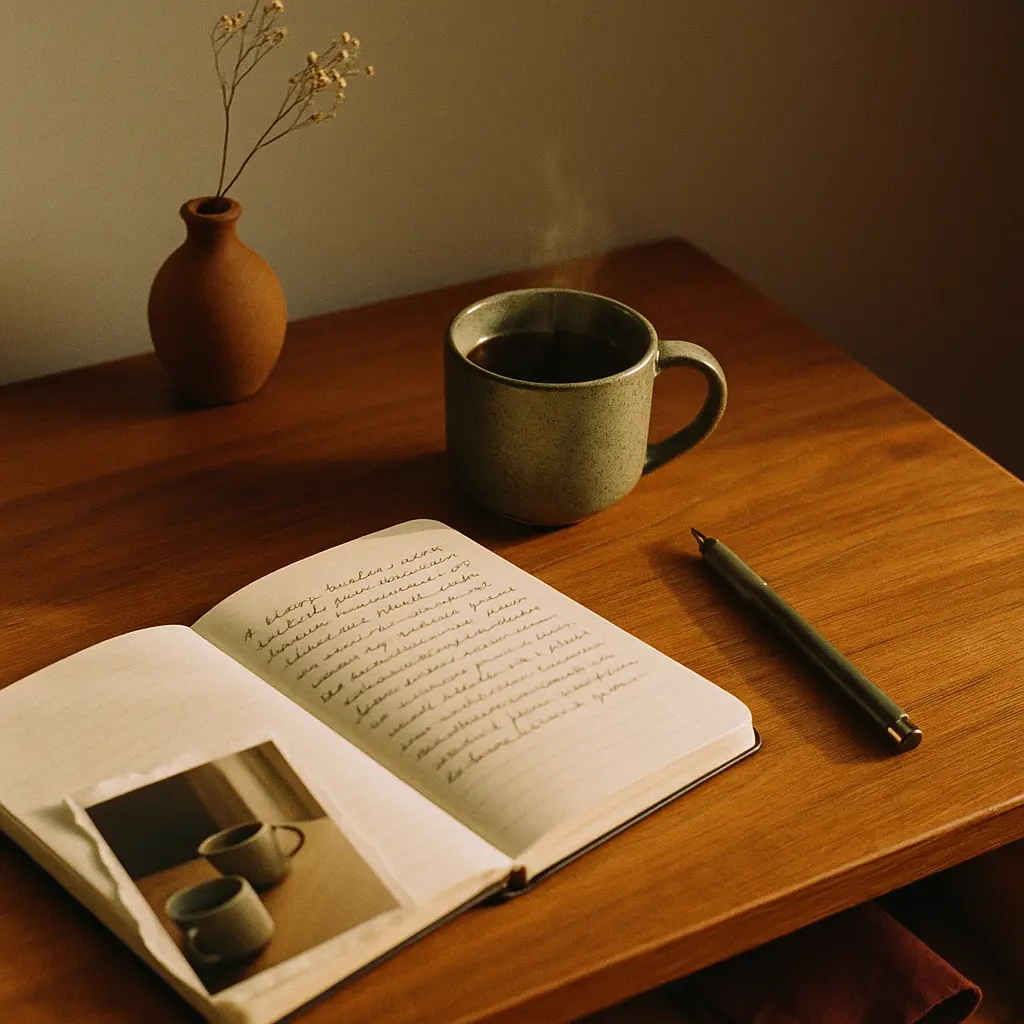
The year before a relationship finally arrived in my life, I had a vision board that didn't have a single romantic image in the conventional sense. It had a picture of two coffee cups on a table. A Sunday newspaper. Morning light. And the feeling I was encoding was someone already here, already home. That's what I got.
Abundance as Texture, Not Currency
This is the category where most people make the biggest mistake: they put images of money on their boards. Stacks of cash. Specific numbers written out. Symbols of wealth that actually feel (for most people) deeply foreign and even a little gauche.
The issue, as I understand it from years with Neville, is that those images rarely produce the feeling of abundance. They usually produce the feeling of wanting abundance. The wanting is not the state. The wanting is the gap.
What produces the feeling of abundance varies by person. For me it's: a well-stocked kitchen. A bookshelf that needs another shelf. A good coat. Quality things that have been lived in. My vision board has images of abundance-as-lived-experience, not abundance-as-bank-statement. If images of numbers move you into the feeling of already having, then use them. But if they produce longing instead of arrival, swap them out.
Something That Has No Practical Purpose
This is my favorite category and the one almost nobody talks about. On every board I've made in recent years, there is at least one image that serves no practical goal. A painting I love. A landscape I have no plans to visit. A color. A piece of furniture that doesn't exist in any plan I have for my apartment.
I include these because they signal to the part of my nervous system that is always calculating usefulness that this board is for something other than striving. The impractical image is a permission slip. It says: you are allowed to want things for no reason. You are allowed to be moved by things that have no ROI.
This, weirdly, often feels like the most expansive part of the whole board.
The Physical Board vs. The Digital Board (And Why I Have Both)
I've made both, in different years and for different purposes, and I think they serve different functions.
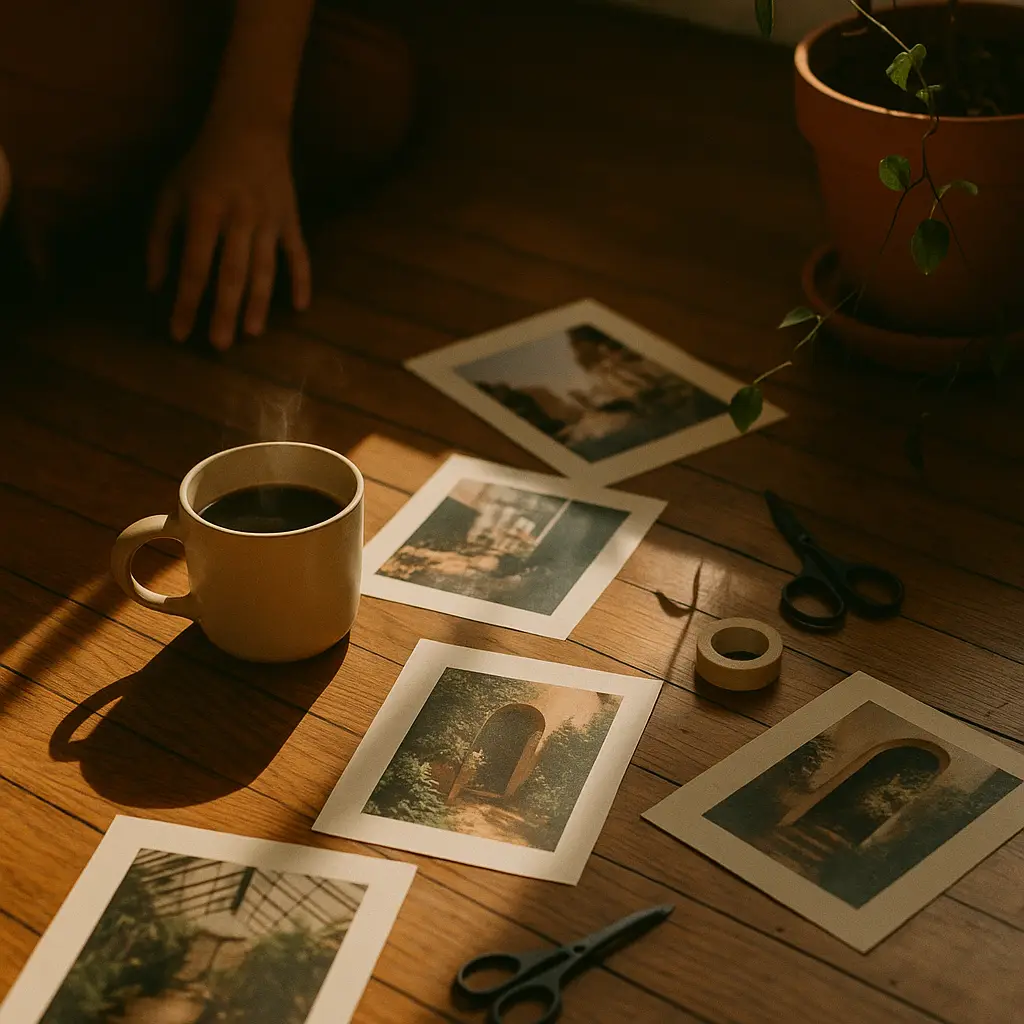
The physical board is slower to make, more intentional. When I'm sitting on the floor with scissors and magazines and the light is going low in the apartment and the cat is doing something ridiculous to a piece of ribbon, the process itself is meditative. There is something about the physical act of cutting and placing that is embodied in a way a drag-and-drop interface cannot replicate. You are using your hands. You are selecting with your body, not just your mind.
The digital board is more flexible, easier to update, better for certain intentions (I know people who use theirs as a phone lockscreen, which means they're seeing it ten or twenty times a day without even meaning to). If you want something that functions as a daily anchor image, digital makes sense. If you want the making of the board to be the ritual, physical makes sense.
I wrote much more about the mechanics of building a digital version if you want the step-by-step: Digital Vision Board: Step-by-Step Tutorial walks through exactly how I structure one.
But the short answer to "which is better" is: the one you will actually look at. The one that moves you when you see it. The one that produces feeling.
What Neville Actually Says About Images
I want to spend a minute here because I think there's a real misunderstanding in the manifestation space about what vision boards are doing from a Neville Goddard perspective.
Neville is not particularly enthusiastic about external images. He is very specifically enthusiastic about inner images, the images generated by imagination, held from the inside, felt in the body, persisted in. When he talks about "the image" in something like The Power of Awareness, he means the mental image you construct in the silence before sleep, the scene implying fulfillment, the moment-after-the-wish-is-granted.
So what is a physical vision board doing in this framework?
My best answer, years in, is that a good vision board functions as a prompter. It is a cue for the internal work. When I look at my board and find an image that produces a genuine somatic response (warmth in the chest, a slight relaxation in the shoulders, something that feels like recognition), that response is the doorway into actual SATS work (State Akin to Sleep, for those who are newer to Neville's method). The external image is a bridge to the internal scene.
The danger is when the external board becomes a substitute for the internal work rather than a bridge to it. When people look at the board and feel longing, or feel the distance between here and there, and call that manifestation practice. That is the board working against you, not for you.
The test is always: does looking at this produce the feeling of having, or the feeling of wanting? If it consistently produces wanting, the images need to change.
Why I Burned One (Almost)
If you're looking for structured support alongside this kind of practice, the store has a small catalog worth looking at.
One summer, I had a board that I stopped being able to look at.
It had been right for a while, or right enough. But at some point the images started feeling like evidence of what I didn't have instead of what I was moving toward. The apartment I'd put on there started feeling like an accusation. I'd look at it in the morning and feel something contracty in my chest.
I didn't burn it (I am, at heart, someone who is slightly afraid of open flames inside apartments). But I took it down. I put it face-down against the wall. And I sat with the question of what had shifted.
What I eventually understood was that I'd outgrown the version of the board but hadn't updated it. The images no longer represented where I was going because I had already arrived at some of them, and the others were pointing toward a version of the future that no longer felt true to who I was becoming.
This is a thing people don't tell you about vision boards: they expire. They should expire. A board that made you cry in January might feel alien by June because you've changed. And when a board stops moving you, the correct response is to update it, not to use the distance you feel from it as evidence that the practice doesn't work.
Someone who has been doing this longer than I have told me once that she rebuilds her board every season and doesn't attach to any particular version. "The board is just where I am right now," she said. "Next season I'm somewhere else." I think she's right.
The Images That Surprise You
Here is the part of the process I want you to pay attention to.
When you are making a board, going through magazines or a folder of saved images or a Pinterest board you've been quietly adding to, there will be an image that surprises you. One that you weren't expecting to want. One that produces a feeling you don't quite have words for.
Grab it. Put it on the board. Do not interrogate it.
The interrogation is the wrong move. The moment you start asking "but what does this mean" or "but how would I even have this," you have taken yourself out of the feeling and back into the analyzing. The feeling came first for a reason. The image produced it for a reason.
Neville writes, in The Power of Awareness, that the assumptions we make without realizing we've made them are often the most powerful. The image that surprises you is the one you've assumed you don't deserve, or the one you've filed under "impossible," or the one that belongs to someone else's life. Your nervous system registered it anyway. That registration is data.
Trust the images that surprise you more than the images you collected deliberately.
A Note on What Belongs Off the Board
I want to say something about the images that don't belong, because I see a lot of advice about this that I think is directionally wrong.
Most vision board advice will tell you to keep things positive, to not put anything "negative" on the board. I think that's incomplete. The question is not whether something is positive or negative. The question is whether the image produces the feeling of already having or the feeling of distance from.
Some images that seem negative (an image of someone resting after something hard, an image of a quiet space that feels like solitude rather than loneliness) can produce genuine arrival feelings. Some images that seem positive (a pile of money, a luxury vacation, an aspirational body) can produce nothing but the ache of wanting.
What belongs off the board is anything that, every time you look at it, produces contraction rather than expansion. That's a personal calibration. Nobody else can do it for you.
What also belongs off the board: images that belong to someone else's life that you grabbed because you thought you should want that. If the image of the corporate corner office produces nothing in you, if you're only including it because someone told you you should want that, take it off. The board is yours. The practice is yours.
For more on making a board that actually functions as a practice tool rather than a decoration, How to Make a Vision Board That Actually Works goes deeper into the mechanics.
2026 Specifically
Let me give you some concrete image directions that feel true to where a lot of people I talk to are right now, in the particular moment of 2026.
People are tired in a way that is different from the ambition-burnout of the early twenties. There's a specific tiredness that comes from having pushed hard and gotten somewhere and realized the somewhere wasn't the thing you thought it was. I see this in readers, I see it in friends who talk about their work with the voice of someone who can see the whole machine clearly now and is not entirely sure they want to keep operating it.
The vision boards I'm seeing that feel most alive right now are the ones that include images of rest as arrival, not rest as recovery. Rest that is not a gap between striving. Rest that is the actual life.
If you are tired, and I suspect you might be, I want to encourage you to put rest on your board deliberately. Not a vacation (vacations carry the energy of escape, of fleeing something). But the image of a Tuesday afternoon with nothing scheduled. A corner of your apartment that feels like yours. A morning where the first thing you do is something you want to do.
That image might be the most radical one on the whole board.
The other image direction I'd offer for 2026: belonging. Not success, not status, not achievement. The feeling of being somewhere that is the right place for you to be. A table where you belong. Work that feels like it came from you and not from a version of you that was performing. A relationship where you don't have to translate yourself.
Belonging, as a vision board category, is underused and I think it's where a lot of the most important manifestation work is actually happening right now.
The store has a small curated catalog of products that complement this kind of work, if you want tools alongside the reading.
The Practice That Runs Underneath It
A vision board, even a great one, is not the whole practice. I want to be honest with you about that.
The board is a tool for accessing feeling. The feeling is what you take into the actual inner work: the SATS session before sleep, the mental scene you hold and live in the present tense, the assumption you practice wearing like a coat. If you want to understand how that process works in more depth, and how the board functions inside a larger framework, there's a lot more on this site to explore. The store also has a small curated catalog of products that complement this kind of work, if you're looking for structured support.
But the board on its own, looked at every day with feeling, is not nothing. It is training the mind to notice evidence of the thing you're moving toward. It is, in the Dispenza framework, priming the brain to recognize matching signals in the environment. It is, in the Neville framework, practicing the assumption of already having by looking at images that trigger that state.
Years ago, the board under my bed was doing something even I didn't understand yet. The feeling was working. The assumption was working, slow and stubborn and mostly underground.
The version of you who already has what's on that board is not someone else. She is the version you are becoming by looking at the board and believing, at least for a moment, that it belongs to you.
That moment is the whole practice. Everything else is support material.