he first vision board I made for money was a disaster. Not because the images were wrong. Because I had no idea what I was actually doing.
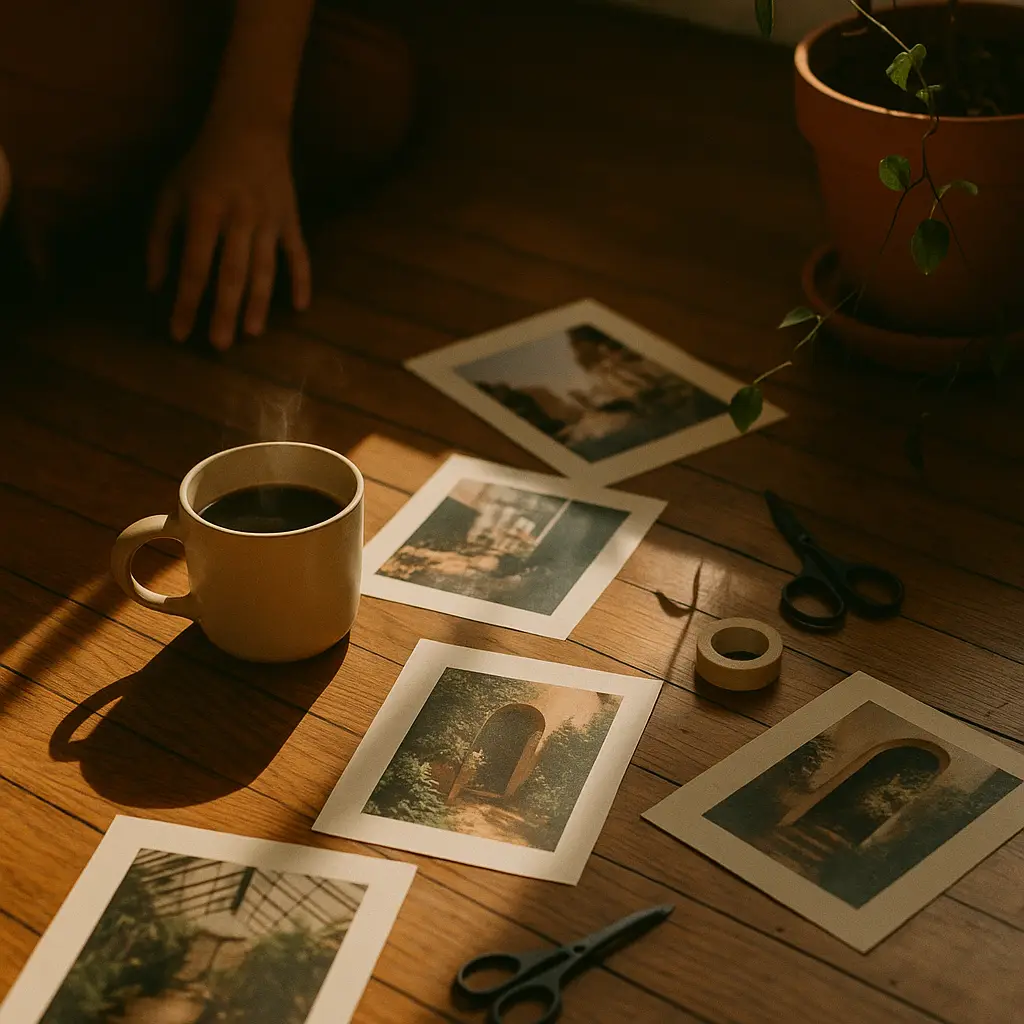
This was during a hard season, not long after everything had come apart. I had a little money set aside, a lot of debt, and a very fragile belief that something about my life could change. I had just started listening to Neville Goddard. I had a magazine, a pair of scissors, and a foam board from the drugstore. And I made a board covered in pictures of cash, luxury apartments, and a woman in a blazer who looked like she had never cried at work in her life.
That board did not do what I thought it was going to do. But the process of figuring out why it didn't work taught me everything about how it actually can.
There is something specific about using this practice for money. Something that makes it different from using it for a relationship or a career goal. And once I understood what that was, the board became a different kind of tool entirely.
The First Problem: Money Is Abstract
If you're looking for structured support alongside this kind of practice, the store has a small catalog worth looking at.
Here is what I got wrong that first time. I was thinking about money as if it were a thing I could paste onto a board and stare at.
A picture of a stack of bills is not money. A picture of a luxury apartment is not your life. And when you print out a number and paste it to foam core, all you're doing is looking at a number. You're not in it.
The brain doesn't care about pictures of things. The brain cares about sensory experience, about the felt sense of a state. Bessel van der Kolk writes about this at length in The Body Keeps the Score: the body processes states, not concepts. What this means for your vision board is that you cannot put an idea on it and expect the feeling to follow.
Money as a concept is a placeholder. Money as an experience is very specific. It's paying for something without hesitating. It's walking into a store and buying the thing you actually want rather than the second cheapest version. It's paying a bill early. It has a particular texture, a particular relationship with your nervous system. That texture is what belongs on the board.
And that texture looks different for every person.
What does financial freedom actually feel like in your life? Not in the life of the woman in the blazer. Not in the life of whoever runs the Instagram account you have been studying. In yours. That specificity is the whole game, and most vision boards never get there.
How to Build from the Inside Out
The way I eventually rebuilt this practice started with a question I found in Neville Goddard's The Power of Awareness. The question was: what would you see, hear, feel, and know to be true if your wish were fulfilled?
Not what would you have. What would you know.
That reframe changed everything for me. Because the version of me who had cleared her debt did not walk around thinking about her debt. She was not staring at a number on a board. She was just living. She was making decisions from a different baseline. She had different thoughts in the grocery store. She woke up in the morning without the particular weight that financial stress puts on a body before the eyes are even open.
So before you touch a single image, I want you to do this: write down what a normal Tuesday morning looks like when the money situation is resolved. Not the moment you find out. Not the celebration. The Tuesday morning six months later, when it is just your life. What are you thinking about? What are you not thinking about? What does your relationship with your bank account feel like? What do you do, practically, with money that you cannot do right now?
That list becomes your source material. The board is just the visual layer over that specific, lived truth.
For me, those Tuesday morning details included things like: ordering the thing I actually wanted at dinner rather than scanning the menu for the price first. Not doing math in my head while standing in the pharmacy line. Being able to say yes to a flight without spending three days talking myself out of it. Buying the cat better food without flinching. Small things. But when I built those into a board, it started to mean something my body could actually respond to.
What to Put on the Board (Specifically)
I am going to be specific about this because "images that resonate with you" is advice that sounds good and means almost nothing.
The categories that work for a money vision board are not the ones you see most often. Let me walk through them.
Ease images. These are pictures of moments that imply the absence of financial stress. Not wealth, exactly. Ease. A woman sitting calmly at a table with paperwork and a coffee. Someone at a farmers market buying something without hesitation. A person in a hardware store picking out materials for a home project. These images are doing something different than a picture of a mansion. They are encoding the nervous system state, not the outcome.
The specific life, not the generic rich life. This is the big one. What is the specific life you are building? If your financial goal has to do with leaving a job you hate, the board should reflect what you do instead, not just "passive income." If your goal is debt freedom, it should reflect what that particular Tuesday morning looks and feels like. Generic wealth imagery keeps the goal abstract. Specific life imagery brings it home.
Anchors to the feeling. Certain images have emotional resonance that has nothing to do with their literal content. A picture of a quiet afternoon. A particular color palette. An image of a room with good light. These images aren't about money. They're about the emotional state that money would make sustainable for you. That state is what you're actually trying to embody.
One number, used correctly. Yes, you can put a number on a money vision board. But the number should be meaningful to you in a specific way. Not "ten million dollars" unless you have a really embodied sense of what ten million dollars actually means in your daily life. A number that represents the first milestone, the first thing that changes, the first breath of air. Make it specific enough that you can feel the moment it arrives.
If you want to go deeper on the layout and selection process, the How to Make a Vision Board That Actually Works article covers the general mechanics in more detail. For money specifically, the principles below take precedence.
The Science Layer (Short Version)
I want to say this carefully because I am not a neuroscientist and this is not medical advice. But there is a reason the visualization practice works the way practitioners describe it working, and understanding the basic mechanism helps you use the board more intentionally.
Joe Dispenza talks about this in his work on the brain and meditation: when you vividly imagine an experience, the brain activates many of the same neural patterns it would activate during the actual experience. The body begins to move into the physiological state associated with that experience. The nervous system starts to regulate around it.
The reason most vision boards don't do anything is that most people look at them without activating that response. They see the images, register them intellectually, maybe feel a brief moment of wanting, and then go back to the same state they were in before. The board becomes wallpaper.
The work is in using the board as a portal rather than a poster. You sit with it. You let the images pull you into the state they represent. You spend time in the Tuesday morning feeling rather than observing the Tuesday morning picture.
This is the difference between looking at the board and entering it. And your nervous system knows the difference immediately.
What does it feel like to enter it? You get quiet first. You let the image land. You give your body a few seconds to respond rather than moving on to the next image. And then you follow whatever feeling starts to open. That feeling, even if it is small, even if it is fragile, is the evidence that the board is working.
Why Money Specifically Requires More Honesty
Here is where I have to say something that might be uncomfortable.
Money vision boards fail at a higher rate than other boards because money is where our most inherited, most defended, most unconscious beliefs live. You can get pretty far on a relationship board while your money beliefs are still intact. The two clusters are almost separate architectures in the psyche. But the money board forces you to confront things the relationship board doesn't.
What do you actually believe about people who have money? What was the implicit story in your family about wanting more than you had? What did the people who raised you say, or not say, about people who lived a certain way? For a lot of us the message came through not with cruelty but with anxiety, the very real fear of someone who grew up with very little. But the message was there: wanting too much is dangerous. Wanting too much will cost you something.
Those beliefs don't disappear when you cut out a picture of a nice kitchen and paste it on foam core. They're underneath the board. They're in the body. And when you sit down to do the visualization work with this board, they surface. They feel like doubt. They feel like "this is stupid." They feel like suddenly needing to check your phone.
The most honest version of this practice includes some inventory of what you actually believe, not just what you want to believe. That doesn't mean you have to resolve every childhood money wound before you can use a vision board. But it means you go in knowing that resistance is going to show up, and that resistance is not evidence the board isn't working. Resistance is evidence that the work is asking you to go somewhere.
Someone, when I described this part of the practice to them a while ago, said: "So you're basically doing therapy with scissors and a glue stick." They weren't entirely wrong. The scissors and the glue stick are the least of it.
The Placement Question (Which Nobody Talks About Enough)
The store has products I'd point a friend toward. Honest reviews, no aggressive upsells.
Where you put the board matters more than most people say.
The default advice is "somewhere you see it often." And yes, that's part of it. But I want to refine this.
The board should be in a place where you see it during a state you can work with. Morning, before the day has gotten to you, is ideal. The liminal space right after waking up, when the nervous system is still soft and the day's worries haven't landed yet, is really one of the best windows for this work. Not because of anything mystical about morning. Because your defenses are lower. The beliefs that argue back have not yet woken up.
If you're putting the board in your office where you also handle emails and deadlines, the context is working against you. The ambient stress of that environment is the state you're actually practicing, not the state on the board.
I kept mine in the bedroom for a long time. Not directly across from the bed, where it would feel like an obligation, but visible when I was doing the slow-morning thing. The cat's food bowl nearby, coffee in hand, the particular quality of early morning light. That context became part of the practice. The board and the state reinforced each other.
If a physical board feels like too much right now, or if your space doesn't cooperate, the Digital Vision Board: Step-by-Step Tutorial covers a different approach that some practitioners find easier to work with consistently. The principles are the same. The container is different.
The Daily Practice Piece
You do not need to stare at this board for forty-five minutes a day. I want to be direct about that because the internet has created an arms race around how much visualization is enough.
What the practice actually requires is consistent, present contact. Two minutes of genuine entry into the feeling of the board beats twenty minutes of looking at it while thinking about what to make for dinner.
Here is what worked for me: a brief, intentional visit. Morning was easiest. I would sit with coffee, look at the specific images I had chosen (not all of them at once, but two or three that had the most charge for me), and give myself permission to stay in the feeling they opened. Not analyzing the images. Not planning how to make them real. Just staying.
And then I would let it go. Close the morning, start the day. Let the state settle into the background rather than chasing it.
The chasing is what breaks it, by the way. The anxious re-checking. The "is it working yet" energy that most of us carry around a money practice because money feels so immediately urgent. That anxiety is the opposite of the state you're trying to embody. You can't feel like someone who has more than enough while simultaneously checking your bank balance every four hours to see if anything has changed.
Ask yourself honestly: are you visiting the board from abundance or from lack? Because the body knows the difference, and the practice lands differently depending on which state you're practicing from.
Whatever you're going through, the store has a small curated catalog of products I'd point a friend toward.
What Happened With Mine
Over the following year, the debt was gone. I have said this before and I will keep saying it because it is true and because it mattered and because it still surprises me.
I am not going to tell you the vision board was the only thing. The work was multi-layered. It was the nervous system work, the self-concept work, the consistency of sitting with a practice through the months when it felt like it wasn't doing anything. It was practical actions: freelancing, saying yes to work I would have previously thought beneath me, learning to hold money differently.
But the board was the visual architecture of the assumption I was working from. It was the daily reminder of what Tuesday morning looked like when the debt was gone. And it held me to a specific, felt version of that reality that kept the practice grounded when the abstract version would have floated away.
The board I have now is different. Quieter. Less about the dramatic reversal and more about the quality of the life that's already here, being extended. Someone who has seen a few iterations laughed when I showed it to her recently, because she knows how much the images have shifted. "You don't need the blazer woman anymore," she said. She wasn't wrong.
If you're building this board for the first time, or rebuilding it because the last one didn't do what you hoped, start with the Tuesday morning question. Get specific before you get decorative. Let the feeling lead the imagery rather than hoping the imagery produces the feeling.
And if you're looking for a broader framework for what goes on a board, Vision Board Ideas for 2026 has a more expansive list worth browsing before you start cutting.
The board is a tool. Like every tool, it is only as good as the understanding you bring to it. But used with intention and specificity, and with genuine honesty about what you believe and what you're trying to shift, it is one of the more powerful pieces of the work I have encountered in years of doing this.
The store has a small curated catalog of products that complement this kind of work, if you're looking for additional support alongside the practice.
Sit with that for a second. The images don't have to be grand. They have to be true.