he first time I heard the phrase "soft life," I was sitting in the waiting room of a dentist's office in midtown, scrolling through my phone on a twenty-minute lunch break I had technically not been approved to take.

Someone on my feed had posted a picture of a linen-draped bed, a tray of fruit, and a caption about choosing ease over hustle. I remember thinking, with genuine contempt, that sounds like a productivity excuse. Then I went back inside and answered seventeen emails before my name was called.

That was 2021. I was twenty-nine, and I was dying by degrees.


The Life I Was Already Living Wasn't Actually Living

I worked seventy hours a week for eight years. Not seventy hours as a dramatic exaggeration, but seventy as a real number I tracked on a timesheet that no one ever reviewed. The agency didn't ask for that many hours. Nobody had to. The culture was self-enforcing. You simply stayed until you couldn't anymore, and then you stayed a little longer, and eventually you couldn't remember what your apartment looked like in daylight.

I had the apartment in Greenpoint since 2019. I rarely saw it except in the dark.

And here's the thing nobody tells you about that kind of schedule: it stops feeling like sacrifice. It starts feeling like you. The exhaustion becomes your personality. The busyness becomes the answer to every question you're afraid to ask yourself. When someone at a dinner party asks what you do for fun, and you realize you really don't know, the easiest thing in the world is to say oh I've just been so slammed and let them nod sympathetically and move on.

I became very good at being slammed.

My nervous system was running a constant sprint. Not because I was in actual danger, but because my body had learned to interpret the ambient pressure of my work life as something worth staying vigilant about. Every email notification was a small alarm. Every Sunday night was a slow dread building toward Monday. Two years on antidepressants (from 2020 to 2022) helped me stay functional. But functional and well are not the same country. They are not even neighboring states.

Then March 2022 happened. A Tuesday night, around 11 p.m. Kitchen floor. Vesta circling my legs in that confused way cats do when they know something is wrong but have no language for it. I was thirty years old and I couldn't get up.

Three weeks after that night, Priya sent me Neville Goddard's The Power of Awareness at 3 a.m. with a message that just said I don't know, just listen to it. Three weeks after that, I was laid off. $8,400 severance. A six-month freelance contract appeared six days later.

I'm not telling you that story to tell you manifesting is easy. I'm telling you that the floor is where I first noticed I had a nervous system at all.

Whatever you're working through, there's a small curated catalog worth looking at.See the store →

The Soft Life Is Not a Trend

What the internet has done to the soft life concept is what the internet does to most things: flattened it into content. Now it's a hashtag populated with candles and bathtubs and women in silk robes who seem to be perpetually on vacation somewhere with good light.

And look, I have nothing against silk robes or good light. But that framing makes the soft life sound like something you buy your way into, or something reserved for people who got lucky. It makes it aspirational in the worst possible sense: out of reach, decorative, and vaguely passive.

The actual soft life, the one I have been building for three years now, is a nervous system state.

It is the difference between a body that operates from chronic threat response and a body that has learned, slowly and imperfectly, that safety is the default. That is not something you purchase. It is something you practice. And the practice is not easy, which is one of the great ironies of a thing called soft.

Bessel van der Kolk writes in The Body Keeps the Score that the body responds to trauma not just emotionally but physiologically. The nervous system gets stuck. It gets trained. It learns to anticipate danger even when danger is no longer present. That's what eight years of a high-pressure career did to mine. I was running a threat response to a conference call. I was running a threat response to my own ambitions.

Learning to be soft, in that context, is an act of deep recalibration. And it starts way before the silk robe.

What I Actually Mean When I Say Nervous System

Here is where I want to slow down, because I think this word gets used a lot in wellness circles and doesn't always get explained.

Your nervous system is not a metaphor. It is a biological system with two primary modes that most people know as fight-or-flight and rest-and-digest. (The more technical language comes from Dr. Stephen Porges' polyvagal theory, which added a third state, social engagement, and which Beatriz explained to me over coffee with a patience I did not deserve given how many times she'd already explained it.)

The short version: your body is constantly reading signals from your environment and from your own thoughts, and based on those readings, it is deciding whether you are safe. If it decides you are safe, resources go toward things like digestion, creativity, connection, and rest. If it decides you are not safe, resources go toward survival.

The problem with a decade of high-stress work (or grief, or chronic illness, or a childhood in a house where money was always frightening) is that your nervous system gets trained to find threat everywhere. Not because you're broken. Because it adapted. It did exactly what it was supposed to do.

But an adapted nervous system is not a free nervous system. And manifestation work, which is really about the feeling you hold in your body, runs through this system. This is why I say the nervous system is not separate from the work. It is the substrate the work runs on.

Does that make sense? Sit with that for a second.

If your body is operating from a threat state, the feeling you are generating is not I have this. The feeling is I need to get this before something goes wrong. Those are not the same feeling. They don't produce the same results.

Practitioners working on this tend to ask about tools. The store is where I'd send them.See what's there →
Whatever you're going through, visit the store. Products that can help, no aggressive upsells.Browse →

The Year I Started Learning How to Be Safe

After the layoff, I had time for the first time in eight years. Real time. Unstructured time. And I want to be honest with you about what that felt like, because I think people expect it to feel like relief.

It felt like falling.

For the first two months of 2022, I could not sit still. I would finish my morning coffee and immediately need to be doing something, answering something, producing something. Vesta would sit on the windowsill in the afternoon light and I would stand in the kitchen convinced I was forgetting a deadline that no longer existed. My nervous system didn't get the memo that the emergency was over. It was still running the old program.

I started reading everything I could find about how to change that. Neville's work was the first thing, and it gave me a framework for the what (change your assumption, live from the end). But Neville doesn't talk much about the body. He was writing in the 1940s and 1950s, and his language is about the imagination, the feeling, the state akin to sleep. It took me longer to find the people who could tell me why it's so hard to sustain that feeling when your baseline is a nervous system that's been running on cortisol for a decade.

Joe Dispenza was part of what helped. Van der Kolk was part of what helped. And honestly, Beatriz was a part of what helped, because she was the first person who made me actually lie on the floor and breathe on purpose instead of collapsing onto it by accident. (She introduced me to some somatic practices around 2023 that I'm still working with. They are embarrassingly simple and they work, which I resent slightly.)

What I was learning, in clumsy fits and starts, was regulation. The ability to notice when my nervous system was spiked and to have something to do about it. Not suppression. Not toxic positivity. Just: I notice I am elevated, here is a thing I can do, and now I am a little less elevated.

The soft life starts here. Not in a hotel lobby or a linen flat sheet. In the ability to return to yourself.

Four Things That Actually Built It

I'm going to resist the urge to give you a listicle, because I really don't think this work is a listicle. But I also know that somewhere in here you want something practical. So here is an honest account of what actually shifted things, in the order they appeared.

First: I stopped performing productivity for an audience that no longer existed.

This sounds obvious until you realize you're still doing it. After I left the agency, I caught myself doing things like scheduling fake meetings on my calendar so the day felt structured, or rushing through lunch because sitting down to eat slowly felt indulgent in a way I couldn't justify. Who was I performing for? No one. The audience had gone home. But I was still on stage.

The first act of building a soft life was noticing when I was performing busyness and asking, quietly, what I was afraid would happen if I stopped. The answer, usually, was something about worthiness. If I wasn't producing, was I allowed to take up space? My mom's voice somewhere underneath that: money is for people who work hard. My grandmother's rosary on the counter every morning before she asked for anything, as if even wanting things required an apology first.

Second: I started treating my body's signals as information.

Not problems. Information. When I felt anxious, instead of trying to think my way out of it, I started getting curious about where I felt it. Chest? Jaw? That coiling thing in the stomach that doesn't have a clean name? Somatic work, which I came to through Beatriz and through van der Kolk, gave me a language for this. The anxiety was not a personality defect. It was my nervous system doing its job, which was protecting me from threats. The invitation was to show it, gently, that the threats had passed.

Third: I got serious about sleep and light and the embarrassingly boring basics.

I know this is where some readers check out, because we have been told to get eight hours of sleep so many times that it has lost all meaning. But I want to tell you that I really did not understand what a regulated nervous system felt like until I had a period of three weeks where I slept consistently, saw morning light before I looked at my phone, and did not have caffeine before 9:30 a.m. The shift was not subtle. It was like turning up the resolution on everything.

Fourth: I found the feeling before the evidence.

This is the Neville piece. The specific application to the soft life is this: I had to stop waiting to feel safe until I had evidence of safety. I had to practice the feeling of safety before it was logically justified. Lying on the floor (on purpose, not in crisis) and breathing and letting my body remember what it felt like to not be in an emergency. Holding the image of a life where mornings were slow and work was meaningful and Vesta was in the sun and I had time to read before noon. Practicing that feeling like a musician practices scales.

Not because pretending fixes things. Because the nervous system learns through felt experience, and the felt experience has to come first.

What the Soft Life Actually Looks Like at 34

I want to give you the honest version, not the aspirational one.

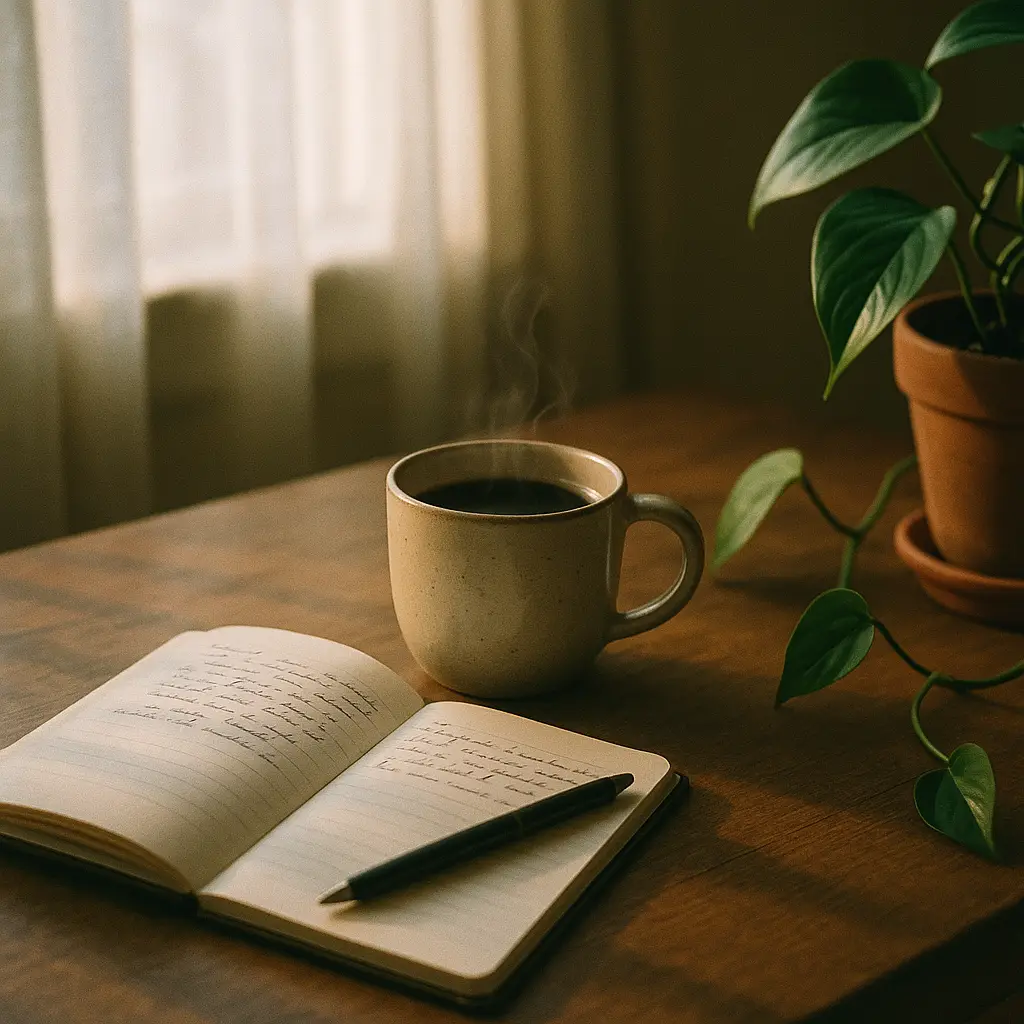
Daniel makes coffee in the mornings. He has a very specific opinion about the grind size that I find charming in a way I could not have predicted. We take our time. This is not because we have no obligations. It's because we decided, somewhere along the way, that mornings were sacred. That the first hour of the day belonged to us.

I still work. I work hard, actually, but differently. Freelance writing and consulting has its own pressures, and there are weeks that feel chaotic. The difference is that I have a body that knows how to come back. When a deadline spikes my anxiety, I notice it. I have things to do about it. I don't white-knuckle through and call it discipline anymore.

The debt, $40,000 of it when I left the agency in March 2022, was paid off fourteen months later. I don't attribute that entirely to nervous system work, but I also don't think it's a coincidence that the debt cleared fastest during the period when I was least frantic about money. The desperation energy, the tight chest, the obsessive checking of accounts. When I got quieter inside, things moved faster outside. That is my honest account, and I'm aware it sounds strange, and I'm not going to pretend otherwise.

The soft life, at 34, in a one-bedroom in Greenpoint, looks like: slow mornings, work I have chosen, a cat who sleeps on a folded blanket in the afternoon sun, a partner who is calm and funny and quietly present. It looks like knowing the difference between a Tuesday I'm legitimately tired and a Tuesday I'm dysregulated. It looks like having the tools to do something about the second one.

It does not look like a silk robe, though I have considered purchasing one. I may be overthinking it.

Building Yours: Where to Actually Start

I'm not going to pretend this is a five-step plan, because it isn't. But here are the genuine entry points.

Start by noticing, not fixing. For one week, when you feel anxious or overwhelmed or that flat, pressured sense of dread, don't immediately try to resolve it. Just notice where it lives in your body and name it. That is the beginning of treating your nervous system as something you're in relationship with rather than something that happens to you.

Protect one transition in your day. The morning is ideal, but any transition works. The moment before you open your laptop. The moment after you close it. The first few minutes in your car before you turn the music on. These are regulation moments. Use them to breathe. Slowly. Long exhale. This sounds embarrassingly small. It is also real.

Find the version of you who already has the soft life, and spend time there. This is the Neville application: the state of being the person whose nervous system is regulated, whose days feel spacious, whose body is not constantly braced for impact. You do not have to earn your way into that feeling. You can practice it right now, for five minutes, lying on the floor with your eyes closed. The nervous system learns through repetition. This is how you teach it.

And if you're looking for structured support on this path, the store has a small curated catalog of products that complement this kind of work. No aggressive upsells. Honest reviews.

What Neville called "the feeling of the wish fulfilled" is not a performance of positive thinking. It is a genuine embodied state. And it is available to you today, in the body you currently live in, in whatever the floor of your life looks like right now.

The soft life begins when you decide your nervous system deserves to come home.

That's all it is. And it changes everything.

For practitioners who want to go further, the store has a small curated catalog.Browse →

Frequently Asked Questions