or a long time, I thought the soft life was something you earned. Like you had to get through the hard part first, and then, if you were lucky and had done enough, you'd arrive somewhere quieter. Somewhere that didn't feel like your chest was a drum someone was still hitting.
I was wrong about that.
The Softness Was Already There. I Just Couldn't Feel It.
The store has a small curated catalog of products that complement this kind of work, if you want tools alongside the reading.
There was a night, years ago, when it all caught up with me, and the thing I remember most clearly is that it wasn't loud. There was no dramatic moment. There was just a realization, landing slowly, that I had been living in a state of emergency for so long that I had mistaken it for normal.
Long hours, for years. A place I barely slept in. A body that flinched at email notifications.
I'd tried the things you're supposed to try, and some of them helped, I think. They'd lowered the ceiling on how bad things could feel. But they hadn't done the thing I actually needed, which was to teach my nervous system that the threat was not, ongoing. That I was allowed to stop bracing.
That part, I had to learn myself.
And I want to be honest with you: it did not look like bubble baths and linen sets and the kind of "soft life" content that showed up in every corner of my phone. It looked like small, slightly boring habits. It looked like pausing before I opened my laptop. It looked like standing in my kitchen for an extra forty-five seconds just breathing before I did anything else. It looked like nothing instagrammable at all.
But those small, boring habits changed the architecture of my days. And eventually, they changed what I thought I was capable of.
What I understand now, after years of doing this work and after conversations with people who have been doing somatic practices longer than I have (and who will tell you in the gentlest possible way that you cannot think your way out of a dysregulated body), is that the soft life, properly understood, starts with the body. Before the aesthetic. Before the nap. Before the boundary you learned to set.
If you want to understand more about what the soft life actually is, as a practice and not just a mood board, the piece I wrote on What Is the Soft Life and How to Build One gets into it more directly. But this article is about the habits. The specific ones. The ones that are not decorative.
The Morning I Started Treating Slowness as Information
There is a thing that happened when my circumstances changed, where I had, suddenly, more time than I had ever had as an adult.
The change arrived faster than I expected it to. I know how that sounds. I also know it's true.
But here is the thing nobody tells you about suddenly having more time: your body doesn't believe it yet. Your cortisol doesn't read the calendar. That first stretch of unstructured time, I'd wake up before dawn with my heart doing the thing it always did, that low-grade alarm feeling, even though there was nowhere I had to be.
The body keeps its own schedule.
What I started doing, at first out of desperation and later because it worked, was to give my body proof. Every morning. Not affirmations. Not visualization, at least not at first. Just evidence that the day did not have to start in a sprint.
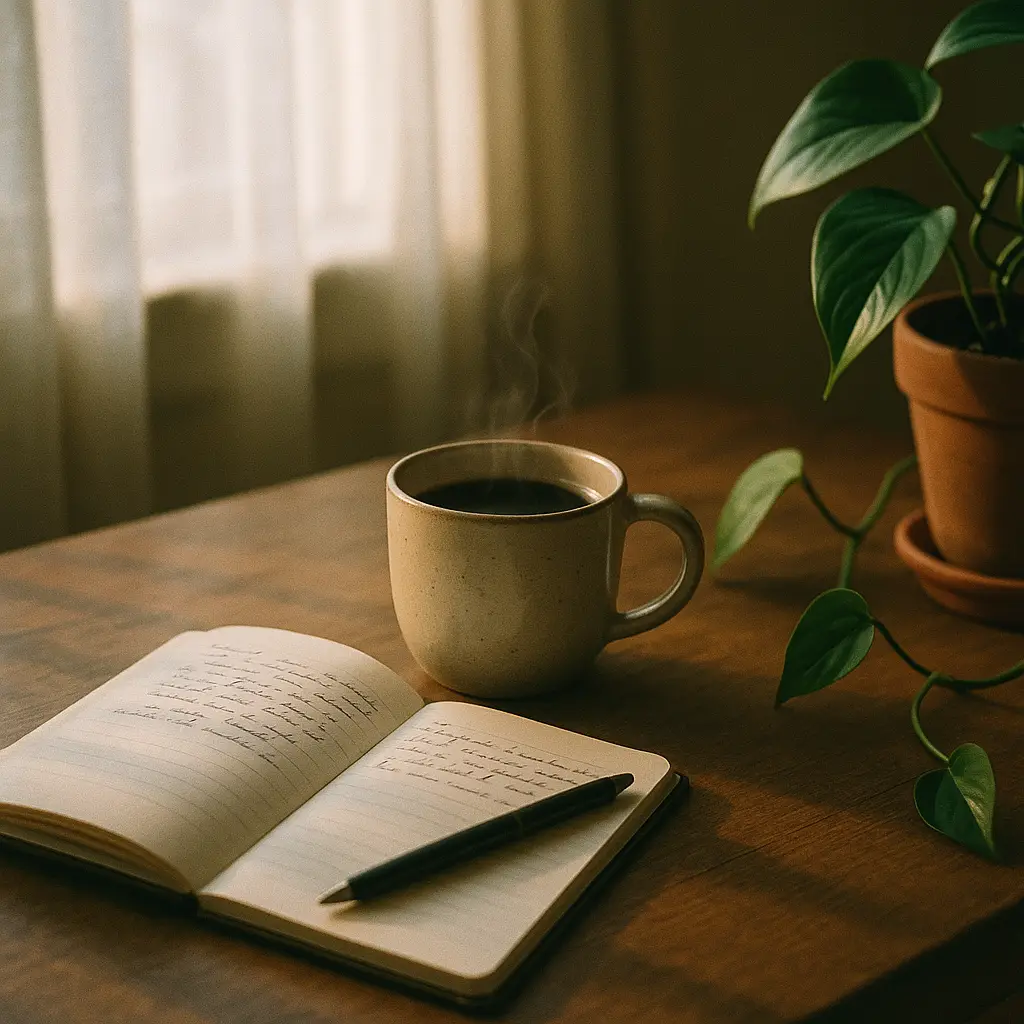
I would make coffee. Not check my phone first, just make coffee. The whole ritual of it: grinding the beans, listening to the sound, waiting for the water. This sounds absurdly simple. It felt, in those early months, like an act of almost deliberate resistance. Like I was telling a very loud, very old part of myself: we have enough time for this.
That "we have enough time" message, repeated in small physical ways, turns out to be the foundation of everything else.
Bessel van der Kolk, in his work on trauma and the body, describes how the body holds onto threat patterns long after the threat has passed. The nervous system learns vigilance as a survival strategy, and it does not unlearn it easily. Certainly not from being told to relax. Certainly not from deciding to be less anxious.
What changes things is accumulated evidence of safety. Small moments of proof, repeated enough times, that eventually the body starts to revise its assumptions.
That's the soft life, friend. That's what it's actually for.
The Habits That Moved the Needle (And Why I Think They Worked)
I want to be careful here. I am not telling you what to do. I am telling you what happened to me, and the pattern I've come to understand underneath it. You will find your own version.
But here is what actually moved things.
Threshold pauses. I started pausing before entering any space or beginning any task that had historically produced dread. Before opening my laptop. Before checking my bank account. Before reading any work-related message. Just five or ten seconds of standing still. Noticing my feet on the floor. One slower breath.
This sounds small. The effect, over weeks and then months, was not small. The pause started to interrupt the automatic chain from "stimulus" to "stress response." My body began to understand that there was a moment of choice between the thing happening and how I met it. That gap is where regulation lives.
Not starting the day with the news cycle or anyone else's emergency. This one is harder than it sounds if you have spent years in a job where responsiveness was its own form of self-worth. I used to check email from bed. The actual first thing. Sometimes before I was fully awake. The hit of urgency was its own drug.
What I replaced it with was really unstructured time before I looked at anything that required a response. Twenty minutes, sometimes more. Just coffee, or reading something physical, or standing by my window watching the street. The street in early morning is very quiet. There are sometimes birds.
This was, and I want to be real with you, surprisingly hard for a while. The urgency had been its own form of purpose. Without it, I had to find out what I was when no one needed anything from me yet. That turned out to be important information.
The deliberate comfort object. I first came across this concept as "anchor objects," and I have since seen versions of it in Dispenza's work on state conditioning. The idea is that you choose a specific physical object and use it consistently during regulated, calm moments. Over time, the object becomes associated with that state, and holding or seeing it can cue the state before it might otherwise arrive.
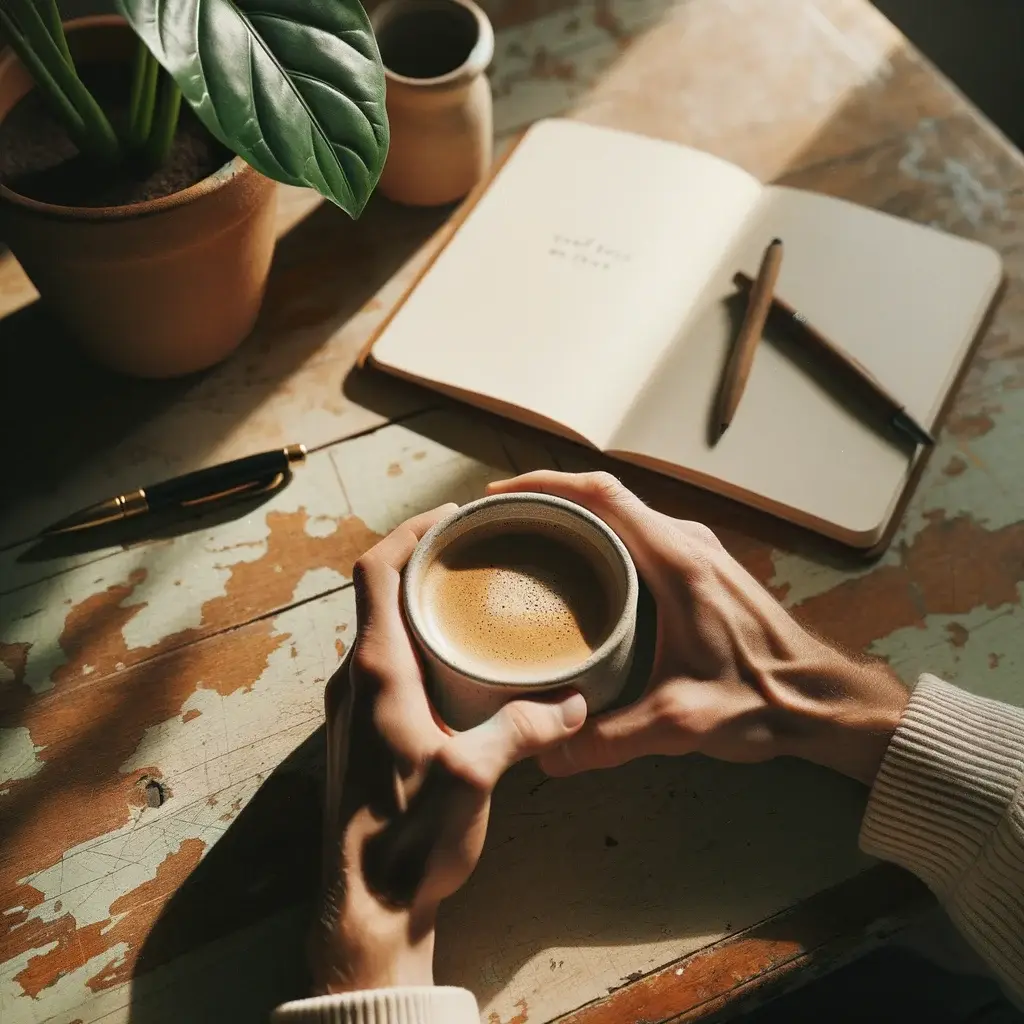
Mine is a particular ceramic mug. It is not a special mug in any objective sense. It is the one I use on slow mornings, the one I hold with both hands. I do not use it when I am stressed or working fast. I use it when I am allowing myself to exist without an agenda.
Sounds a little ridiculous. Works in a way that still slightly surprises me.
Cold water on the wrists and the back of the neck. Someone first mentioned this to me a while back, and I dismissed it completely. Then I tried it during a period of particularly high anxiety around a money situation, and something in my body just.. settled. The physiological reason involves the vagus nerve and the body's cooling response, but I honestly don't fully understand the mechanism. I just know that it works faster than almost anything else when things are escalating.
Slowness at the end of meals. This is maybe the strangest one, or the one that sounds the least like a "manifestation practice," but eating quickly was one of my most embedded stress behaviors. The kind of thing you do when you have thirty minutes for lunch and you've been doing that for years and years. Deliberately slowing down during meals, actually tasting things, staying at the table for a few minutes after finishing, was a surprisingly powerful signal. Digestion is, apparently, something the body only does properly when it doesn't think it's running from something. I had spent years barely digesting.
What Happens When the Nervous System Doesn't Change
Here is the part of the soft life conversation that doesn't come up enough.
You can learn all the manifestation practices in the world. The Neville Goddard techniques, the revision method, the SATS practice, the conscious scripting. And they will work, to a point, if your nervous system is available to receive what they're doing. If you can actually inhabit the feeling.
But if your body is stuck in a threat loop, if it's bracing for the thing to collapse, for the money to run out, for the call that changes everything, then even when something good arrives, you won't be able to feel it land properly. The good news will register as suspicious. The breathing room will feel like the moment before the other shoe drops.
I know this because I watched it happen in real time, in those first months after everything shifted.
Good things were happening. The new work was real. What I'd been braced against was easing, slowly at first and then faster. By the time the worst of it had cleared, the change had become really clean and uncomplicated. But for a long stretch in the middle, every piece of good news arrived wrapped in this particular anxiety that I would later understand as my nervous system's inability to tolerate positive uncertainty as distinct from negative uncertainty.
Someone who had done more of this work than I had at the time said something to me that I've thought about almost every week since. She said: "Your body doesn't know the difference between 'something is about to go wrong' and 'something is about to change.' It calls them both the same thing."
And that was exactly it. The anxiety I felt when something good was arriving was structurally identical, in my body, to the anxiety I felt when something bad was approaching. Same racing. Same tightening. Same low hum of not quite being able to sit still.
The soft life habits, the pauses, the anchor mug, the cold water, the slow meals, started to teach my body that good change was survivable. That I didn't have to defend against it. That I could let it in.
The Question Nobody Asks About the Soft Life
What does it mean to let the good in?
Sit with that for a second.
Because I think most of us are working very hard on our practices, our visualizations, our scripting, and we have done barely any work on whether our bodies can actually receive what we're calling in. Whether we can tolerate the feeling of things going well without immediately scanning for the problem in it.
I asked someone this once, someone who teaches this work, and she said the thing she finds hardest to teach is not the technique. It's the allowing. Getting people to stop being vigilant long enough to notice that they're okay right now.
And here is what I've learned: allowing is physical before it's mental. You cannot think yourself into an open nervous system. You have to practice it in the body, slowly, with repetition, with small proofs accumulated over time. The mind will follow the body, eventually. But the mind is a very bad leader for this particular project.
Which is, in the end, why the soft life is not an aesthetic. It's a nervous system repair protocol wearing comfortable clothes.
I'm not going to pretend that sounds romantic. It doesn't. But it's what actually changed things for me, and I think if you're honest with yourself, you already know that the bubble bath alone wasn't going to do it either.
The Thing About Animals
There is a reason pets kept appearing in the research on stress regulation before I knew there was research on stress regulation.
A cat sitting in your lap does something that I have come to understand as one of the more reliable regulation tools in a day. The weight of it. The purring, which has an actual frequency that the body finds settling. The fact that the animal requires nothing except presence, and gives back warmth.
I used to dismiss this as sentimental. I no longer dismiss anything that works.
The point is that soft life habits don't have to be sophisticated. They have to be consistent and they have to be felt in the body. A cat on your lap is as legitimate a nervous system intervention as any breathwork practice.
The sophistication is not in the tool. It's in the understanding of what the tool is doing.
If you're looking for structured support alongside this kind of practice, the store has a small catalog worth looking at.
The Part That's Actually Hard
I want to end on something real.
There is a phase of this work that nobody advertises, which is the phase where your nervous system is changing enough that the old urgency no longer fits, but the new ease hasn't fully settled either. You're between states. You've stopped running on adrenaline, but you haven't yet found the steadier energy underneath.
That phase feels like nothing is working. It feels like you've given up something (the driven, relentless thing) without having gained something yet. It is a really uncomfortable place to be, and I spent several months there without knowing what it was.
What it was, I now understand, was transition. My system downregulating from chronic overdrive. The discomfort was real, but it wasn't evidence that something was wrong. It was evidence that something was finally changing.
Someone still working the kind of hours I used to work asked me once, over dinner, what had been the hardest part of leaving. And I said something like: "Learning to stay when nothing was demanding that I run." She was quiet for a long time after that.
The soft life habits are, at their most honest, a practice in learning to stay. To be in the room with your own life without the adrenaline telling you that you should be somewhere more urgent.
And that, more than any aesthetic or any morning routine or any curated linen, is the actual practice. The work. The thing that makes the other things (the manifesting, the calling things in, the becoming the version of you who already has it) actually land somewhere real.
The habits I've described are not a prescription. They are proof of concept. Proof that it's possible to change the baseline. Proof that the body, given enough time and enough small consistent evidence of safety, will stop treating life as an emergency.
The things I'd been braced against eased. I built something I actually want to spend my days on. And none of it felt the way I expected it to feel, because by the time it arrived, my nervous system had changed enough that I could actually receive it.
That's the thing the soft life is for, friend. This is real. Not the candles. Not the cashmere. The receiving. The capacity to let the good actually land.
And that capacity is built in the body, one quiet habit at a time.