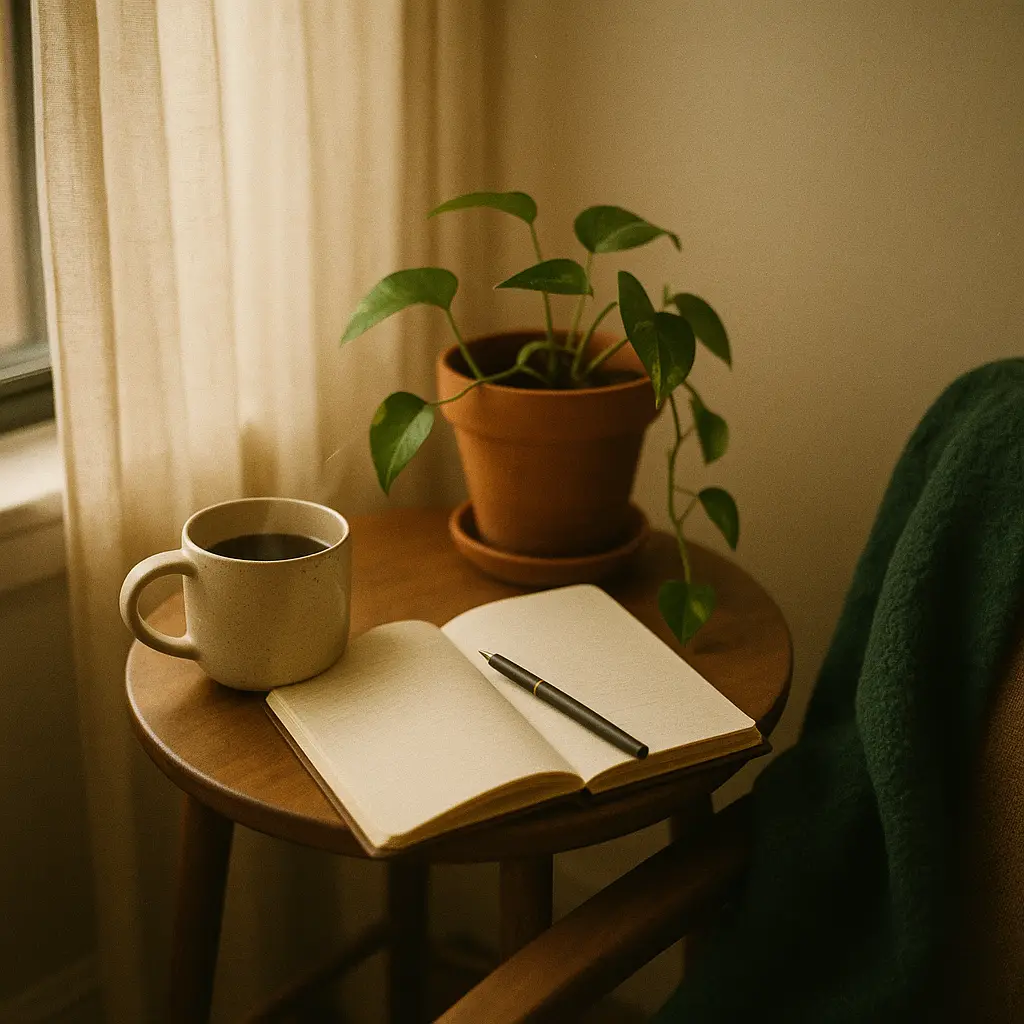
here's a version of the soft life conversation that stays entirely on the surface. Silk pillowcases. Slow mornings. The aesthetic of ease.
And then there's the version that actually changes something.
I want to talk about the second one.
The Permission You Keep Waiting For Someone Else to Give You
If you're looking for structured support alongside this kind of practice, the store has a small catalog worth looking at.
I spent years running at a pace that, in retrospect, I'm not sure any human body is designed to sustain. The punishing hours were the floor, not the ceiling. I told myself it was temporary. I told myself it was the price of something. I'm still not entirely sure what I thought I was buying.
By the time I finally hit the wall, my nervous system had been in a low-grade emergency state for so long that I'd stopped noticing it. That was the scariest part. I thought the hypervigilance was just personality. I thought the constant readiness was ambition.
What I've learned in the years since is that the soft life isn't a reward for finishing the hard one. The softness is part of the work. The regulation is the practice.
Sit with that for a second.
Because if you're waiting for permission to slow down, to ask for less friction, to stop performing productivity at all hours, I don't think anyone is going to hand it to you. I think you have to write it yourself.
What the Nervous System Actually Wants
Here's the part nobody told me in those early months after the breakdown: my body didn't know it was safe yet.
I had, by every external measure, a less pressured life than the one I'd just escaped. The immediate financial pressure had eased. And I still couldn't sleep past 5 a.m. I still braced every time my phone buzzed.
The nervous system doesn't update on logic. It updates on accumulated evidence, delivered slowly, over time. Bessel van der Kolk's research makes this plain: the body keeps score in a way that doesn't care about your spreadsheet of reasons why you should feel fine now.
What the body needs is repetition. Safety cues, repeated. Rest, taken seriously. Signals that the emergency is actually over.
The soft life, when it's real and not a mood board, is a nervous system intervention. The slower morning isn't laziness. The boundary around your evenings isn't selfishness. They are, as far as your biology is concerned, medicine.
What Soft Doesn't Mean
I want to be careful here, because I've seen the soft life framing used as an excuse to opt out of everything difficult, and that's not what I'm describing.
A friend who has been doing somatic and nervous system work longer than I have said something once that I think about constantly. They said that softness without intention is just avoidance wearing a prettier name. This is someone who works hard, shows up, finishes things. And who has also built an entire architecture of ease around that effort.
That's the version I'm interested in. Ease as infrastructure, not escape.
Anne Lamott writes about grace as something that can enter only when you stop clenching. I think about that a lot in the context of manifestation work, in the context of abundance, in the context of any state of being you're trying to move toward. Clenching keeps things out. Softness is what allows something to actually land.
So when I talk about permission to live softly, I mean permission to stop bracing. To let things come to you, at least sometimes. To stop treating rest as something you have to earn every single day.
The Version of You Who Already Has It Is Rested
This is where the Law of Assumption and the nervous system science meet, and they meet here more precisely than anywhere else.
Neville Goddard's framework, as I understand it, is about occupying the state of the wish fulfilled. Living from the end. Assuming the feeling of the person who already has what you want, and letting that assumption do the work.
What does the version of you who already has the relationship, the money, the career, the ease, actually feel like in her body? Is she braced? Is she running on adrenaline? Is she checking her phone every four minutes waiting for the other shoe to drop?
Probably not.
The embodied state of someone living in abundance is, almost by definition, a regulated nervous system. Not checked out. Not passive. Regulated. Present. Capable of receiving.
What I had to learn, slowly and with a lot of false starts, is that the inner work and the physical work are not separate tracks. You can't think your way into the feeling of safety if your body is still living in the emergency. At some point, the practice has to move into the body.
That's why the soft life matters to me as a practitioner, not as an aesthetic. What really matters is what it signals to your nervous system about who you are now and what you're available for.
The Practical Piece Nobody Wants to Talk About
Resting is a skill. I say this as someone who had to learn it from scratch as an adult, and it was really one of the harder things I've done.
The first time I tried to take a Saturday completely off, I lasted about two hours before I opened my laptop. My body didn't know what to do with unstructured time. Rest felt dangerous in a way I couldn't fully articulate. Like something bad would happen if I stopped moving.
What I needed was scaffolding. Small, repeatable rituals that my nervous system could start to associate with safety. The morning coffee that didn't come with a to-do list attached. The walk without headphones. The book in the evening that had nothing to do with anything useful.
These things sound so small. They are so small. And they accumulated into something my body started to recognize as a pattern, which is the only way the nervous system actually changes.
If you're trying to build a softer life and you feel guilty every time you stop producing, I want to offer you this: the guilt is not a moral signal. It's a conditioned response. It is the voice of a system that learned, somewhere, that your worth was contingent on your output. And that voice can be unlearned, but only by giving your body repeated evidence that nothing terrible happens when you rest.
Start with one small thing. Not an overhaul. One thing you do, this week, that is entirely for the purpose of feeling good in your own life. Take it seriously. Repeat it.
That's the work.
Why Your Body Might Be Arguing With Your Desires
I hear from a lot of readers who are doing everything right on paper. They're scripting. They're visualizing. They're doing the inner work. And they still feel like something isn't moving.
What I often notice, when I talk to people in this position, is a kind of background hum of tension that they've normalized. The shoulders are up. The breath is shallow. The body is still scanning for threats even while the mind is trying to imagine abundance.
And here's the thing about that state: it sends a signal. Not a metaphysical signal, necessarily, but a very real physiological one. A body in a stress response is a body oriented toward threat management. The cognitive resources, the emotional bandwidth, even the ability to notice and act on opportunities, are all quietly redirected when the nervous system is in survival mode. Joe Dispenza talks about this at length, the relationship between the stress chemistry in the body and the contraction of perception that follows.
You can't fully inhabit the feeling of someone who has what you want if your body is organized around not having it, around bracing against the lack. The two states are physiologically incompatible.
Does that mean you have to be perfectly regulated before manifestation works? No, and I'd never claim that. But it does mean that the soft life practices, the rest, the ease, the deliberate lowering of your own threat response, are not supplementary to the work. They are the work.
The store has a small curated catalog of products that complement this kind of work, if you want tools alongside the reading.
The Letter You Write to Yourself
Here's something I started doing a while back that I've recommended to more people than I can count. I call it the permission slip, and it is exactly as simple as it sounds.
You write yourself a letter. Not a list of affirmations. Not a scripting practice. A letter, from yourself to yourself, giving you explicit permission to live the way you actually want to live.
Permission to rest without a reason. Permission to say no to things that drain you. Permission to want what you want without explaining it. Permission to move slowly when everything around you is moving fast. Permission to let something be easy.
You can write it by hand if that matters to you. I find that it does, for something like this. There's something about the physical act of writing the permission down, in your own handwriting, that makes it feel like a document rather than a wish.
Read it on the days when the guilt comes back. Keep it somewhere you can find it.
This is not a revolutionary practice. It is almost embarrassingly low-tech. And I have watched it do something real for people who had never once in their adult lives given themselves permission to stop performing.
The soft life starts with that letter, friend. Or something close to it.