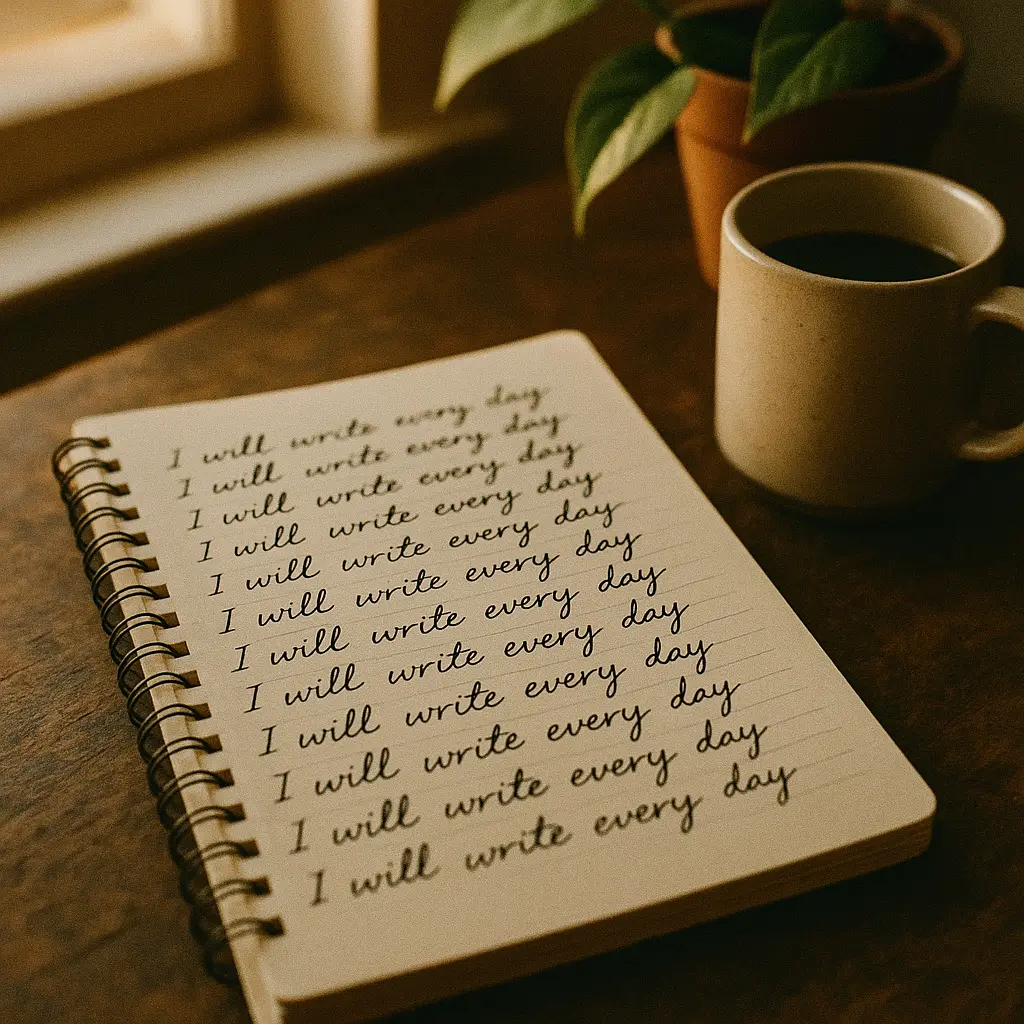
here are at least six versions of the 369 method floating around, and most of them contradict each other in some detail that ends up mattering.
Three times in the morning, six times in the afternoon, nine times at night. Or is it three times a day for 33 days? Or 45? Write the full affirmation or just the feeling? Keep it short or let it run long? Some people swear by a specific notebook. Others say the notebook is irrelevant. Somewhere in the middle of all this, the actual practice gets lost.
I want to try to unsort it.
The Core Structure Everyone Agrees On
The store has a small curated catalog of products that complement this kind of work, if you want tools alongside the reading.
The numbers come from Nikola Tesla, or at least from the mythology around him. He reportedly believed 3, 6, and 9 held some kind of mathematical significance in understanding the universe. Whether or not that's accurate to Tesla's actual thinking, the numbers got attached to a writing practice that works roughly like this: write your affirmation three times in the morning, six times in the afternoon, nine times at night.
That's it. That's the original skeleton.
What no one agrees on is what you write, how long you do it, or what "writing" actually means in practice. And those aren't small details.
The variations exist because different practitioners have different relationships to the mechanics. Some people need the structure to feel rigorous. Others need it to feel light. Some do better with long, sensory affirmations. Others with short declarative statements. The version that works for you depends less on finding the "right" method and more on knowing which friction you can sustain.
The Original 3-6-9
Three affirmations in the morning. Six in the afternoon. Nine at night.
The affirmation stays the same across all three sessions. It's usually one sentence, present tense, written as if the thing is already real. "I am so grateful now that I have the resources I need." Something in that shape.
The logic is repetition as assumption. You're not trying to convince yourself of something through willpower. You're trying to write it enough times that the hand starts to move before the mind objects.
Practitioners who like this version tend to be people who already have some kind of writing practice. They're used to sitting down with a notebook. The three daily sessions fit into existing rituals, morning pages in the morning, a journal check-in midday, something before bed.
Where it breaks down: if your afternoons are unpredictable, you will miss the six-session more than any other. And missing it starts to feel like failure, which poisons the whole thing. If your schedule has no predictable midday window, this version will frustrate you within two weeks.
The 33x3 Variation
Write the affirmation 33 times for three consecutive days.
This one comes from a slightly different logic. The repetition is concentrated rather than distributed. You're going deep in one session rather than spreading across three.
The 33 x 3 tends to work better for people who struggle with consistency across the day but can commit to one long session. If you're a morning person who can sit for twenty minutes before anything else happens, this might be your version. The math works out to roughly the same number of repetitions as a week of the original method, but compressed.
The risk here is monotony. Writing the same sentence 33 times requires a kind of meditative patience that not everyone has. Some people find it boring in a useful way, the way pulling weeds is boring, repetitive enough to get out of your own head. Others find it tedious in a way that breeds resentment toward the practice. If you're writing faster and faster just to get to the end, you've already lost the thread.
The 45-Day Container
Some practitioners extend the method to 45 days instead of 33. The reasoning is that 45 days takes you through a full biological cycle plus a buffer, the idea being that a longer container creates deeper reprogramming.
I'm honestly agnostic on the specific number. What I notice is that people who do the 45-day version tend to take the whole thing more seriously, which might just be self-selection. If you're willing to commit to 45 days, you're probably someone who's going to do the work regardless of the container.
What the longer timeline does offer is a lower stakes daily session. You're not trying to cram transformation into 33 days. There's room to have an off day, to miss one afternoon, to come back the next morning without catastrophizing. That lower-pressure container is real and worth something.
People who have been doing this kind of work a long time tend to swear by longer containers for anything involving deep identity work. I once heard it put this way: 33 days is enough to start a habit, but 45 days is enough to start to believe it. That distinction landed.
The Feeling-First Variation
This is where the method gets more Neville-adjacent and less rote.
Instead of writing a statement of fact ("I have X"), you write a statement of feeling ("I feel the relief of having X" or "I am so grateful that X is already mine"). The shift is small on the page and enormous in practice. As Neville Goddard wrote in Feeling Is the Secret, the feeling is the prayer. The words are just the delivery mechanism.
The feeling-first variation asks you to actually feel something while you write, which is harder than it sounds. Most of us can write an affirmation in autopilot. Writing one while simultaneously inhabiting the emotional state it describes requires attention. You have to slow down. You have to pause mid-sentence and check in with your body.
This is the version I find most consistent with the actual logic of the law of assumption. Your assumption is the fact you live from, not the fact you arrived at through logic. Writing from the feeling plants the assumption at the level where it can actually take root.
The downside: it requires more time per session. You cannot rush through 33 feeling-first repetitions. If you try, you'll write the words without the feeling, which is the one thing this variation specifically asks you not to do.
The Shortened Statement Variation
Whatever you're going through, the store has a small curated catalog of products I'd point a friend toward.
Some practitioners use a single word or a short phrase rather than a full sentence. "Abundance." "Already done." "I have it." The repetition stays the same, 3-6-9 or 33x3, but what you're writing is so compressed it takes almost no time.
The argument for this version is that the logical mind has less to grab onto. A full sentence can trigger argument ("but do I really?"). A single word bypasses that entirely.
The argument against it is that a single word carries less charge. There's nothing to feel into. "Abundance" is abstract in a way that "I am so grateful my rent is covered and I have breathing room" is not.
What I've seen is that the shortened version works best as an entry point, something you can actually do on a bad day when the full version feels impossible. Think of Legally Blonde's Elle Woods: she showed up when she felt least equipped, and doing the thing, even imperfectly, kept her in the game. Using a shortened 369 on your worst days keeps you in the practice. And staying in the practice, even in reduced form, is worth more than the perfect version you skipped.
How to Choose
Ask yourself three things.
First: when in the day do you have the most reliable, uninterrupted fifteen minutes? Morning, midday, or night? If the answer is morning only, you want 33x3 or the shortened version. If you have all three windows consistently, the original structure might suit you.
Second: do you need repetition to feel like ritual, or does repetition make you tune out? If the act of writing by hand feels meaningful to you, the longer versions will reinforce the practice. If you start writing faster just to finish, you'll need the shortened version or a different method entirely.
Third: what is the actual thing you're working on? Deep identity work tends to benefit from longer containers. Specific practical desires, a job, a sum of money, a conversation that needs to happen, tend to respond faster to concentrated short-term methods.
There is no universally correct version. The method that fits your life is the one you'll actually do. A practice you maintain imperfectly for 45 days will move more than a perfect version you abandoned on day four.
The store has products I'd point a friend toward. Honest reviews, no aggressive upsells.
The One Thing All Variations Share
Every version of the 369 method asks you to return to the same assumption, repeatedly, across time.
That's the mechanism. A desire held once in a moment of inspiration does not create the conditions for its own fulfillment. The repetition is what shifts the baseline. You're writing toward a version of yourself for whom the thing is already ordinary, already expected, already unremarkable.
The specific numbers are, honestly, a scaffold. They give the rational mind something to hold while the deeper work happens underneath. Use them. But stay loose enough to recognize that the scaffold serves the work, not the other way around.
If you're building out a broader practice around methods like this, the store has a small curated catalog of products that complement this kind of work.
And if you want to go deeper into the assumption-first approach before choosing your variation, there's a reason Neville Goddard's framework keeps coming up. His Feeling Is the Secret is short enough to read in a single sitting and specific enough to actually change how you approach a session. Start there if you haven't.